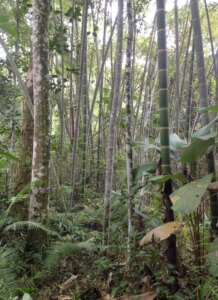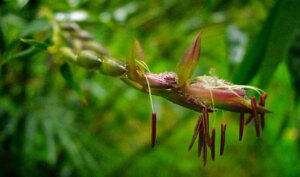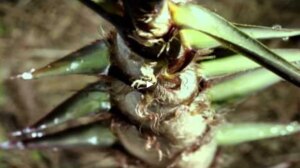

Puncturing bamboo node diaphragms to help preservative solution reach the inside of a Guadua angustifolia pole does not reduce its compression or shear strength. While the claim that drilling holes in the nodes weakens structural bamboo is common online, the engineering data says otherwise. A peer-reviewed study tested drilled poles against undrilled ones and found no statistically significant difference in mechanical performance.
A Quick Explainer Before We Get to the Data
Bamboo poles are hollow, but not all the way through. Along the pole are solid rings called nodes. Inside each node sits a thin internal wall called the nodal diaphragm, which is what actually seals one hollow section off from the next.
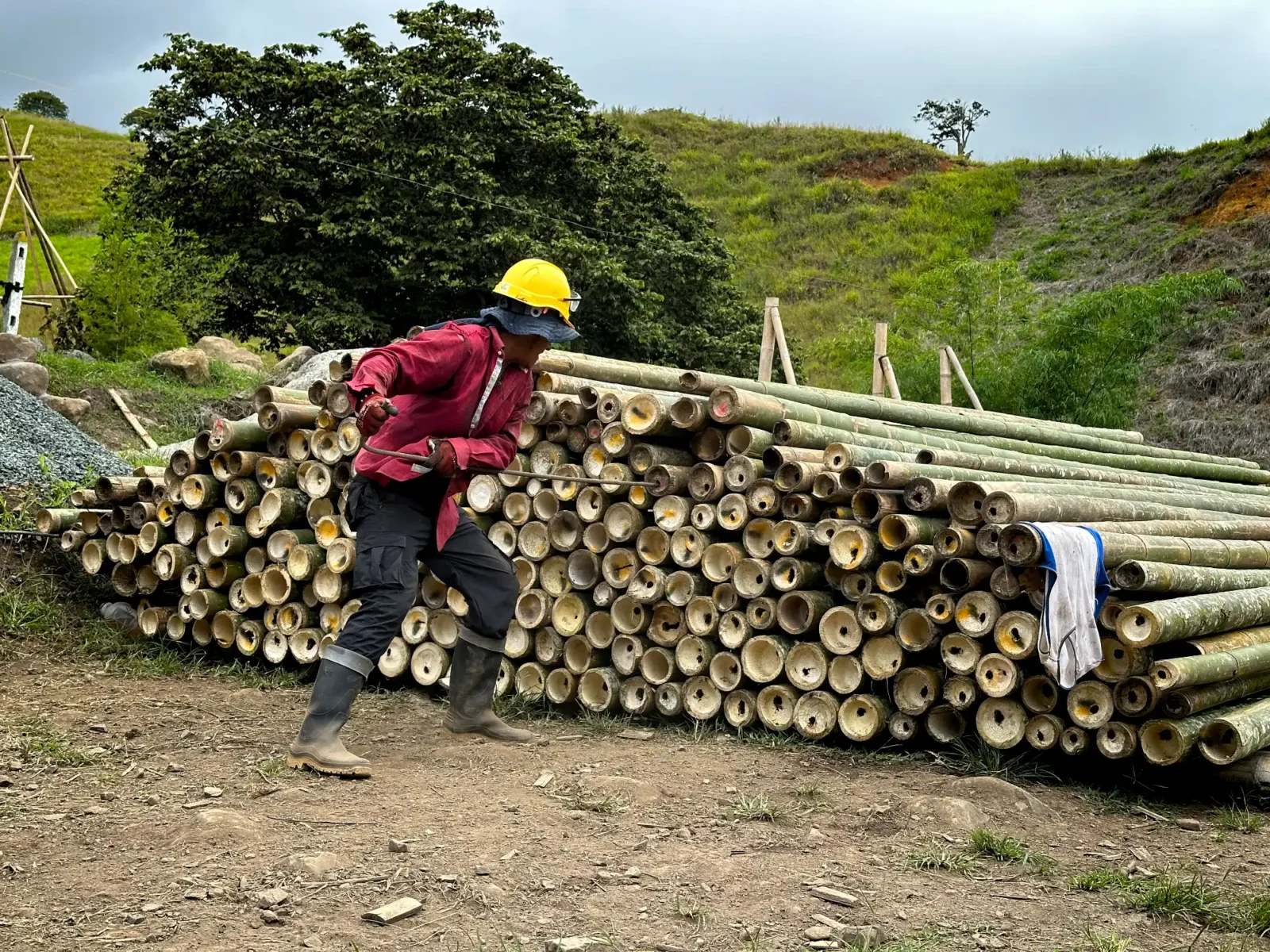
That nodal diaphragm becomes a problem during preservative treatment. Bamboo’s outer surface is dense and silica-rich, which makes it nearly impossible for any liquid to soak in from outside. The inner part of the wall takes up preservative far more easily, since it is made of more porous fibers. So the standard way to treat a pole is to fill the hollow interior with boron preservative solution and let it soak into the wall from the inside out, not from the outside in.
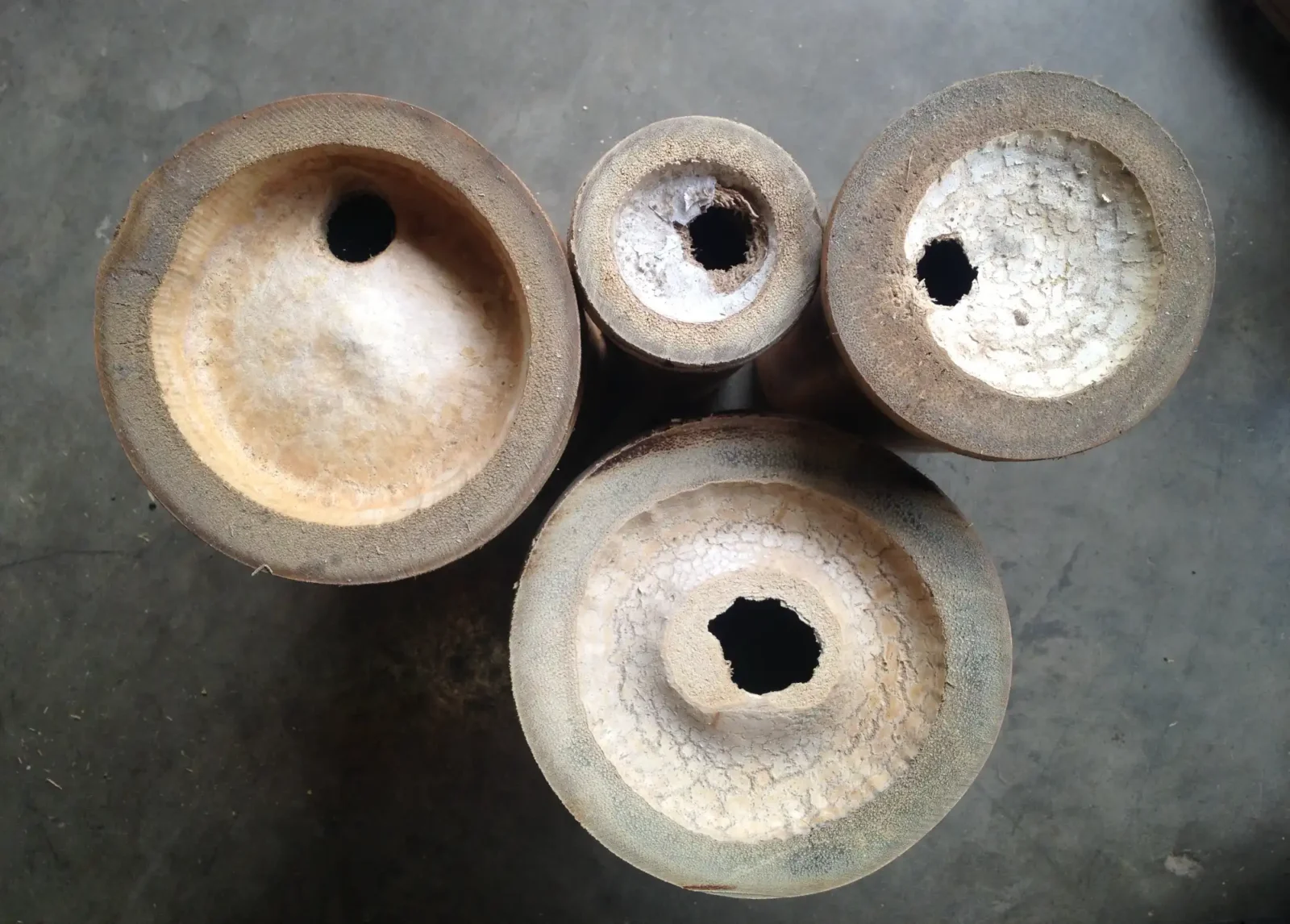
This method only works if the solution can reach every section. Before treatment, we drill a small hole through each nodal diaphragm, letting the solution flow through and fill every section along the pole. The question this article answers is simple: does puncturing bamboo diaphragms weaken the structural pole?
How the Study Tested Drilling on Guadua Bamboo
To find out exactly how drilling affects structural integrity, researchers evaluated 40 culms harvested from a certified Guadua forest in Pereira, Colombia. The samples came from the commercial section (the lower middle part of the culm between 3 and 9 meters up) which is the exact section used for structural bamboo construction. From these culms, they cut 120 test samples and split them into two groups:
- Group 1 (Drilled): 60 samples had the nodal diaphragm drilled, exactly replicating the preparation used before treating a pole with preservative.
- Group 2 (Undrilled): 60 samples were left untouched as the control group.
Every sample was tested two ways: how much load it could bear before failing under compression, and how much force it could resist before failing under shear. Both tests followed ISO 22157:2019 and NTC 5525, the official test standards for Guadua angustifolia.
The Result: No Strength Loss From Drilling the Nodal Diaphragm
The researchers ran a statistical analysis (ANOVA) to compare the drilled poles against the undrilled ones. The result: no meaningful difference in either compression strength or shear strength. In plain terms, whether the nodal diaphragm was drilled or left alone made no real difference to how much weight or force the pole could take before it failed.
Researchers use a measure called a p-value to judge whether a difference between two groups is real or just random noise. A high p-value (above 0.05, as it was here) means the difference is small enough to likely be just natural variation between individual poles, not a true effect of drilling.
Guadua angustifolia: Drilled vs. Undrilled Culms, No Significant Difference (p>0.05)
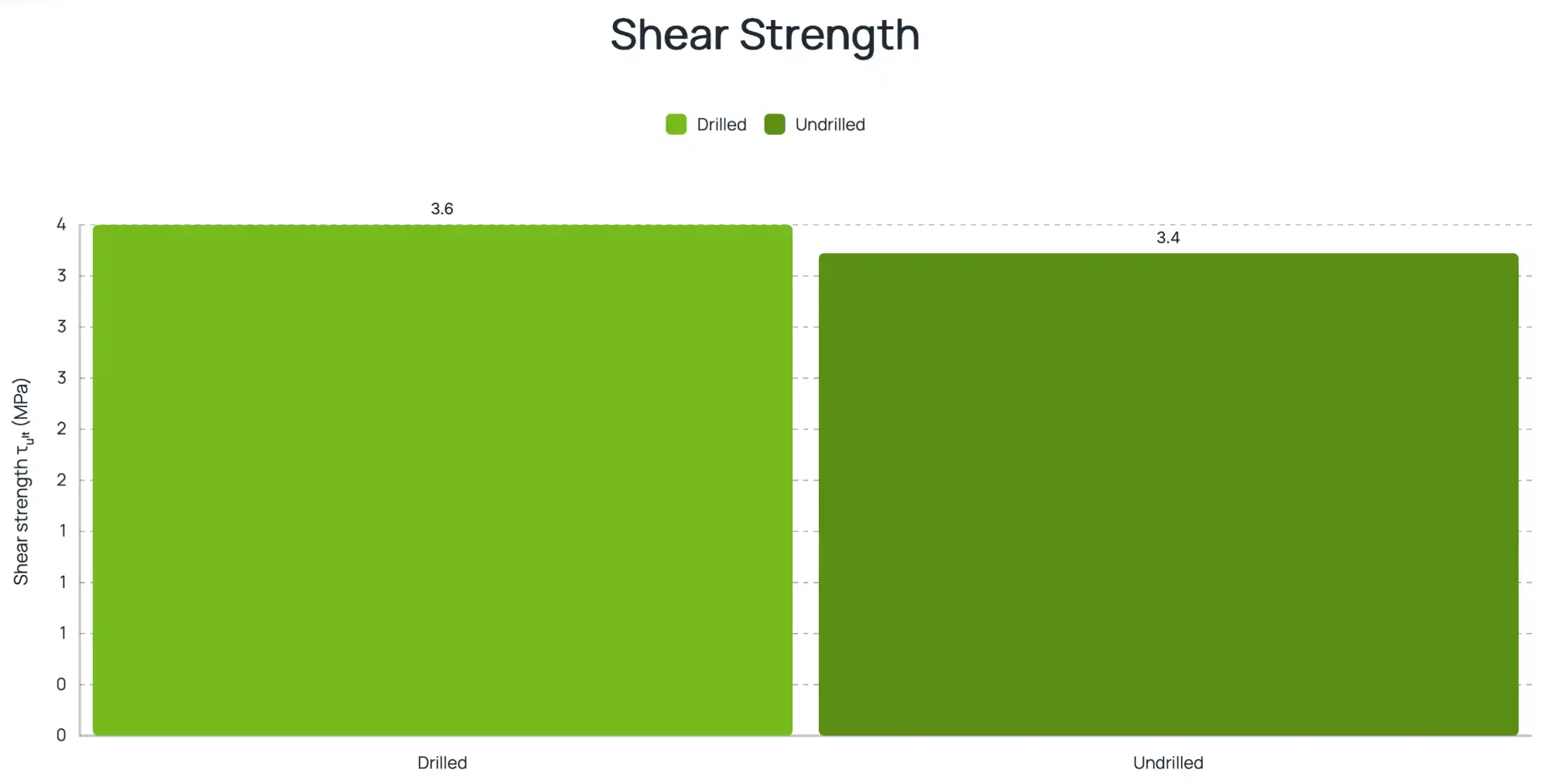
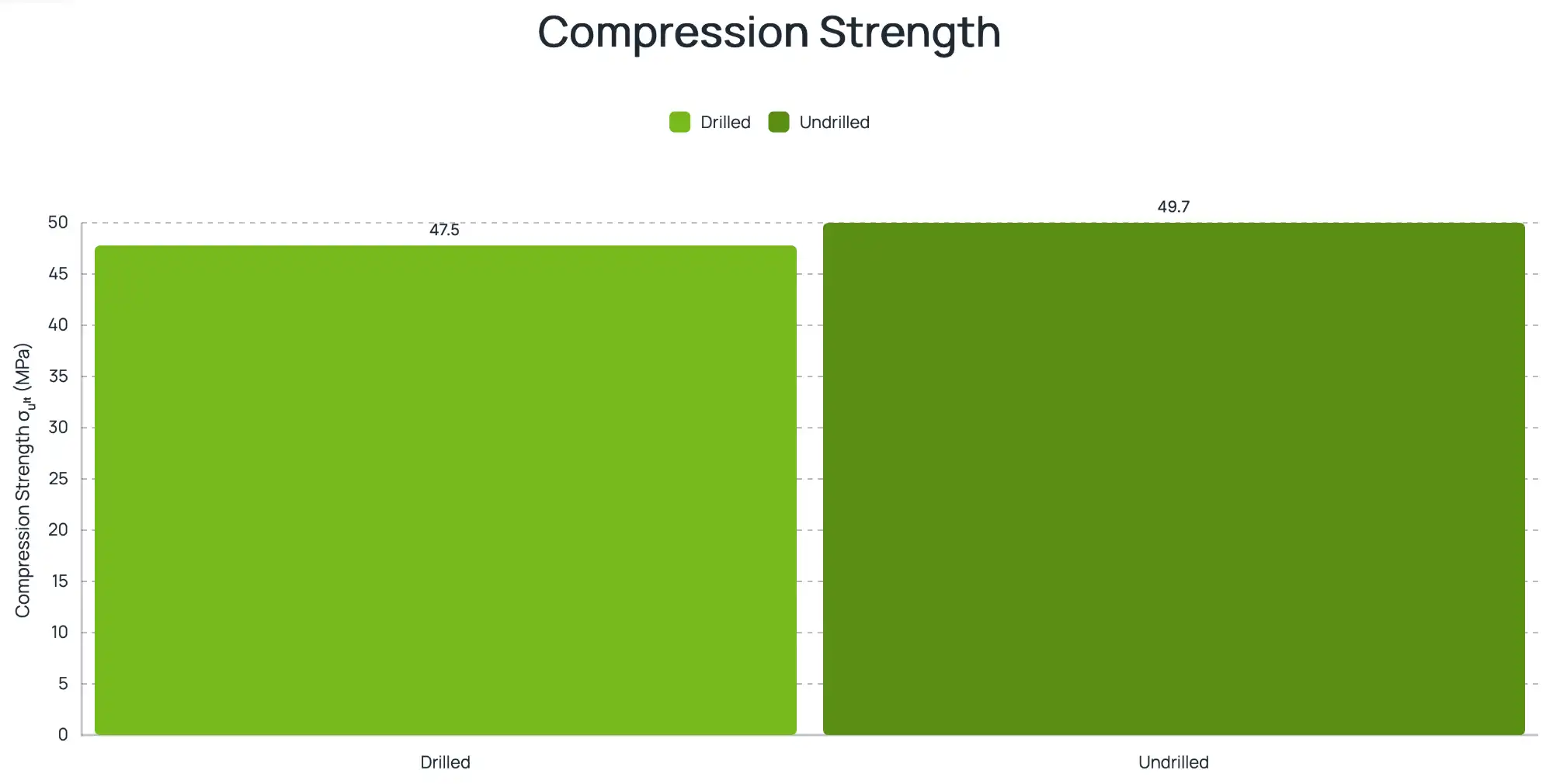
Age-confirmed maturity subgroup. Values approximate, read from Figures 5 & 6 of Camargo & Suarez (2014).
The charts above uses the study’s most reliable data. The researchers sorted poles by maturity two ways: one group by visual signs like color and lichen growth, another by tracking each pole’s actual age from the day it emerged. The chart uses the age-tracked group, since knowing a pole’s real age is more reliable than judging it by appearance.
Shear strength came out at roughly 3.6 MPa drilled versus 3.4 MPa undrilled. Compression strength came out at roughly 47.5 MPa drilled versus 49.7 MPa undrilled. Megapascals (MPa) are the metric engineering units used to measure how much force a material can resist.
Undrilled poles were not consistently stronger on either measurement. That is exactly what you expect from something that has no real effect: the numbers land close together with no clear pattern, well within the normal range of variation you’d see between any two poles.
| Property | Drilled | Undrilled | Study’s Overall Average |
|---|---|---|---|
| Shear strength | ~3.6 MPa | ~3.4 MPa | 3.5 MPa |
| Compression strength | ~47.5 MPa | ~49.7 MPa | 47.8 MPa |
Note: Drilled and undrilled figures are approximate, read from the study’s published charts (Figures 5 and 6), for the age-tracked maturity group specifically. The overall average is the exact figure printed in the study.
Across the full study, both maturity groups combined, average shear strength was 3.08 MPa and average compression strength was 41.6 MPa. The authors note these numbers match previously published figures for the species.
Averaging the drilled and undrilled figures for the age-tracked group gives (3.6 + 3.4) / 2 = 3.5 MPa, which matches the study’s stated shear strength of 3.5 MPa exactly. The same works for compression: (47.5 + 49.7) / 2 = 48.6 MPa, close to the study’s stated 47.8 MPa. The small remaining gap is normal biological variation. Two poles from the same forest, same age, and same treatment will always test a little differently from each other. That is not evidence that puncturing bamboo weakens the pole; it is just the ordinary variation you see when testing any two natural bamboo elements.
Why Drilling the Nodal Diaphragm Doesn’t Weaken the Pole
The reason this works out comes down to how a bamboo pole is physically built. Nearly all of its mechanical strength comes from fiber bundles packed into the outer wall, and the part of the node you can see and touch on the outside of the pole. The nodal diaphragm is a completely different part. It is soft internal tissue sitting in the hollow center of the pole, away from where the densest, load-bearing fibers are concentrated.
That is why a single drilled hole does not show up as lost compression or shear strength in laboratory testing: the fibers that carry those loads are in the outer wall, not the diaphragm itself. This does not mean the diaphragm has no structural role at all; it still helps the pole resist buckling and hold its round shape under load, properties this particular study did not measure. What it does mean is that removing a small section of it for preservative treatment is not taking away its axial strength.
This matches an earlier study by González et al. (2008), cited by Camargo and Suarez, which also found no effect on compression strength when comparing poles with and without the diaphragm. Two separate studies, same result for this specific property.
Is Drilling Necessary for Bamboo Preservation?
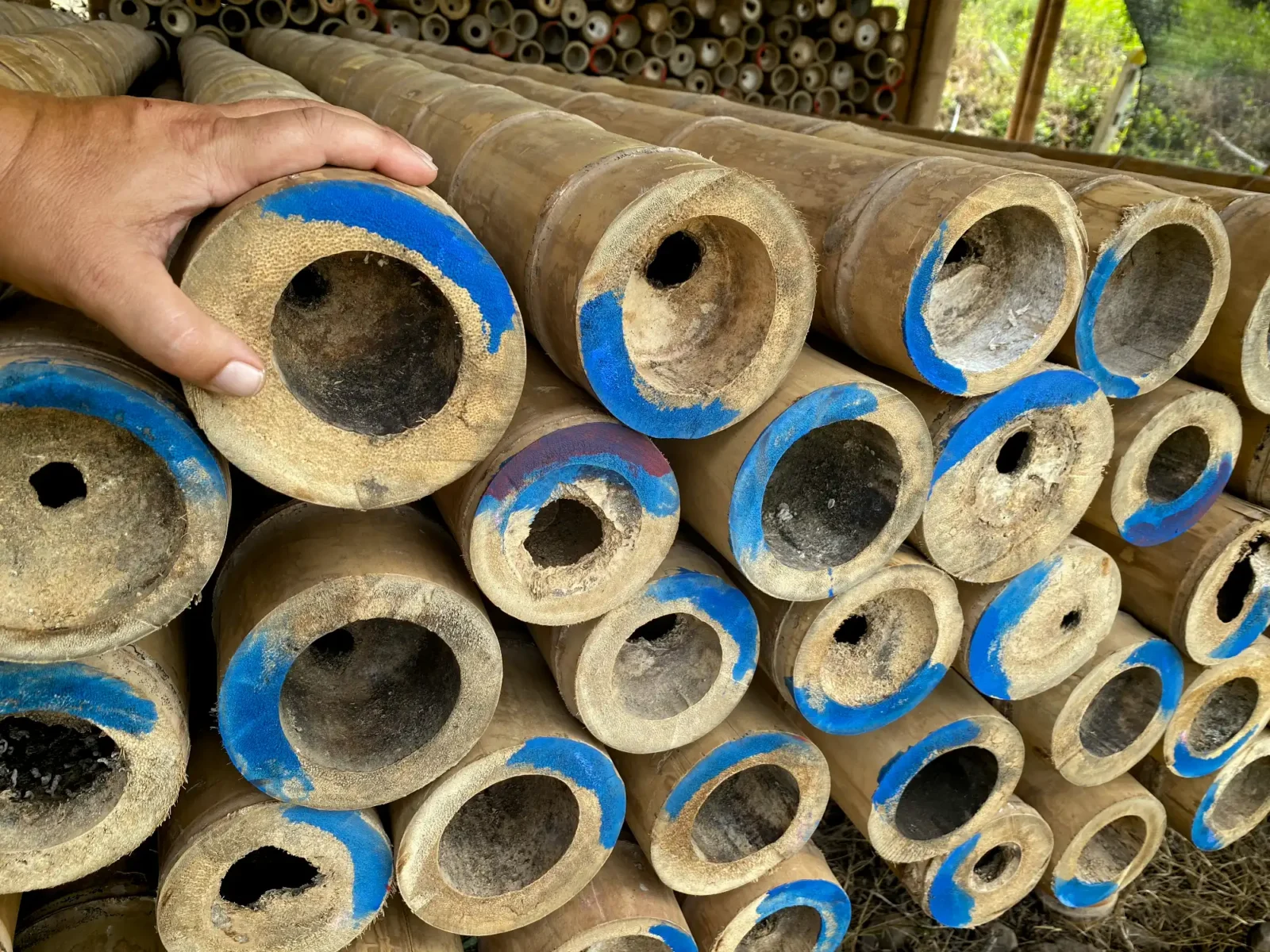
Yes. Puncturing bamboo diaphragms before treatment is standard practice when using a boron preservative, and is required for structural guadua under Colombia’s NSR-10 Building Code. Since the nodal diaphragm blocks the preservative from flowing freely into the interior of each section, drilling it is what makes a professional immersion treatment work at all. This study shows you do not have to choose between structural longevity and a strong pole. Drilling helps the treatment do its job without costing you any mechanical strength.
Natural Diaphragm Openings Observed at Harvest
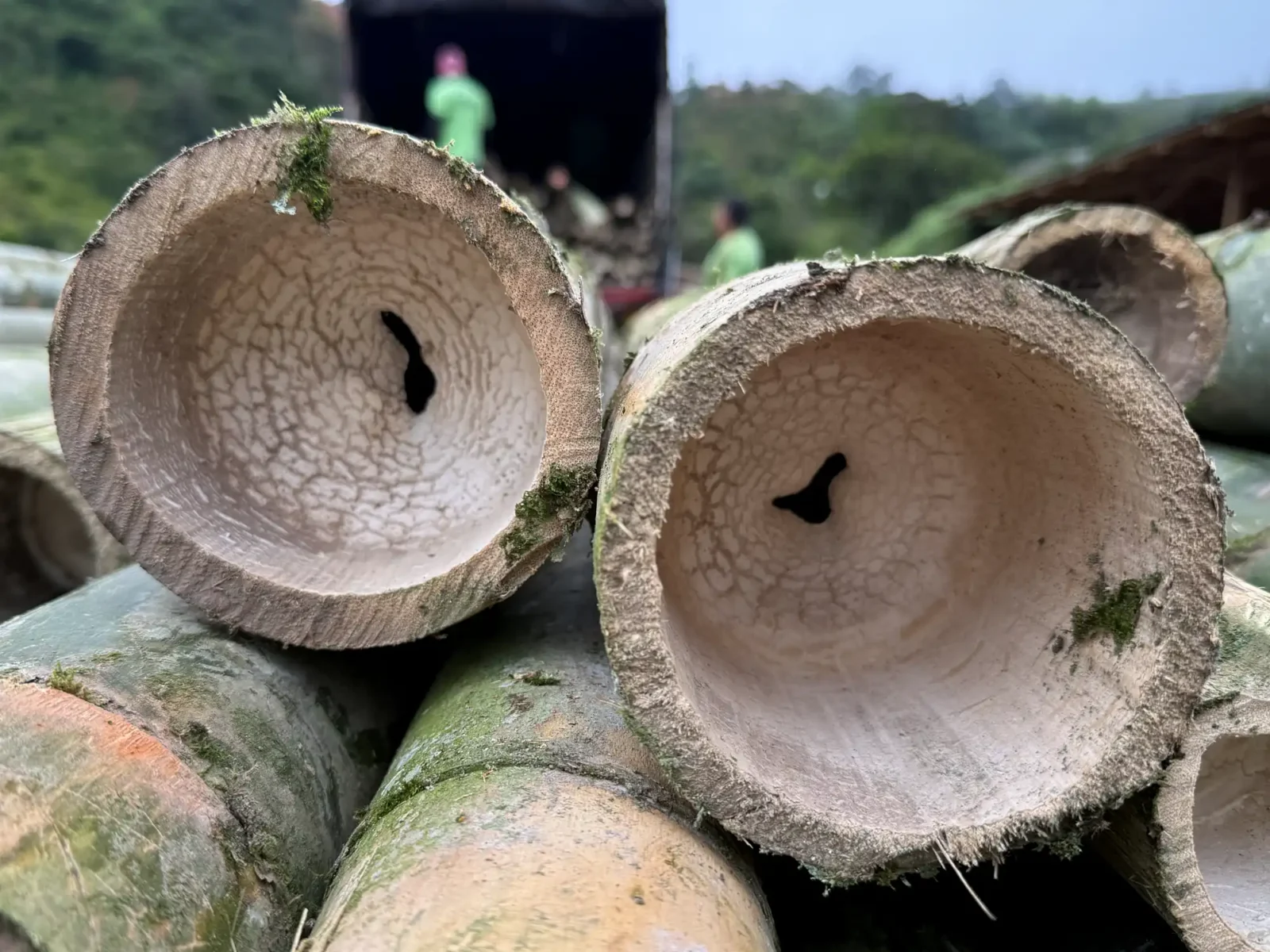
This engineering data lines up with a biological feature we observe regularly at our bamboo processing facility in Colombia. Many freshly harvested, still-green poles arrive from the forest with a small natural opening right in the center of the nodal diaphragm before any mechanical drilling has taken place.
The opening is typically smooth, rounded, and beveled, not a jagged tear. This seems to indicate that the diaphragm never fully closed during the rapid growth phase of the young shoot. We haven’t found any published research explaining why this happens yet.
What This Study Didn’t Test
This study explicitly isolated compression and shear strength on drilled and undrilled poles. Bending (flexural) and tensile strength were outside its immediate scope. The study’s authors note these would be good candidates for future research.
Have questions about how our structural Guadua bamboo poles are selected, graded, and treated before export? Get in touch with our team to discuss your project’s specific engineering requirements.
Reference: