
Culm Sections:
Wall Thickness & Internode Length
Guadua Bamboo® Grading Standards
Understanding Bamboo Culm Sections
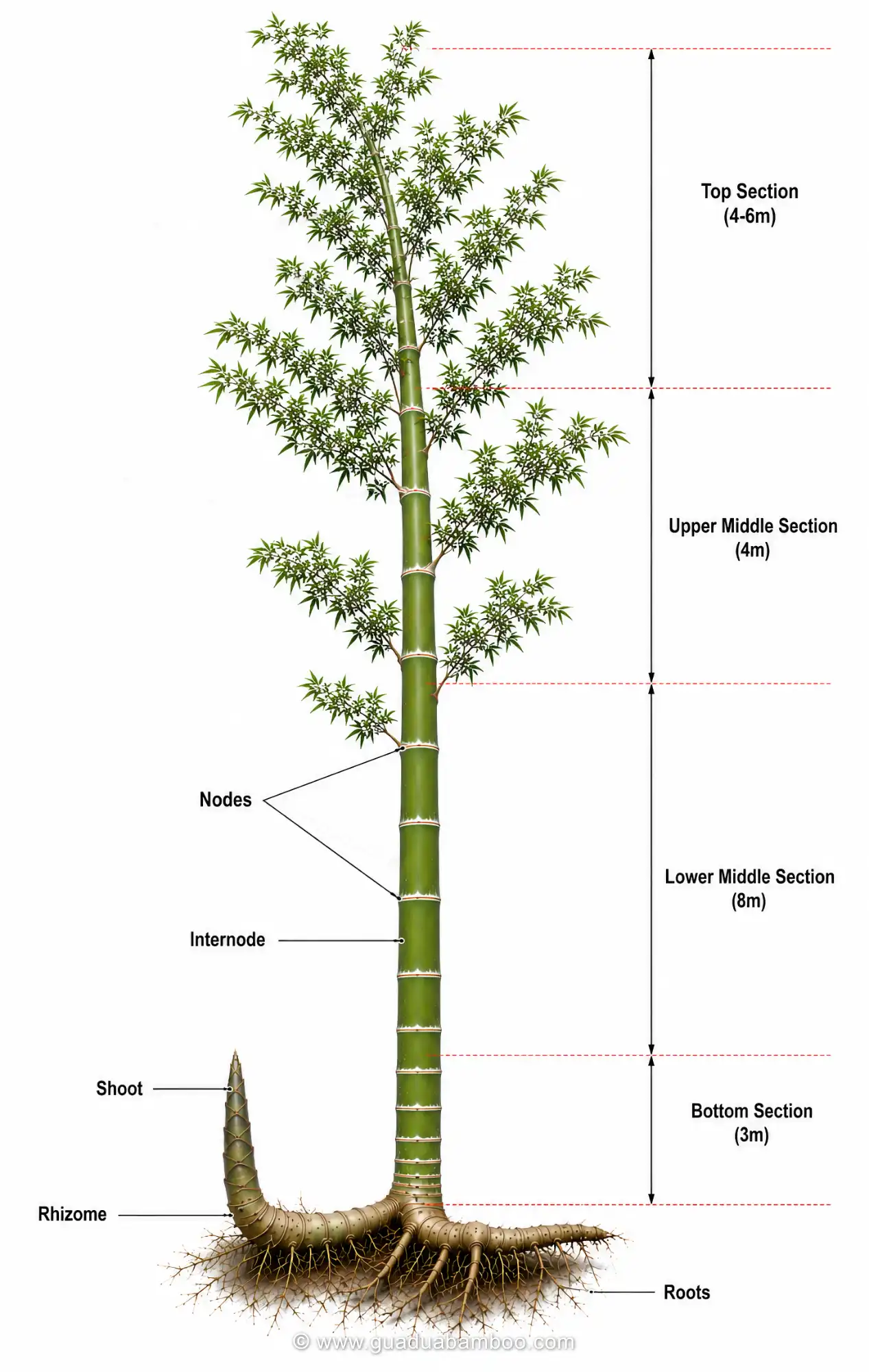
When designing or building with Guadua angustifolia, it is a fundamental mistake to treat a bamboo pole as a uniform cylinder. A single culm naturally tapers from the ground to the top. Guadua angustifolia culms have an average diameter of 10.7 cm at breast height and an average length of 19.6 m. Such culms usually consist of around 75 internodes, each with different lengths and wall thicknesses depending on their position in the culm.
To deal with this natural variation structurally, the culm is divided into 4 distinct sections based on their position and physical characteristics: the Bottom Section, the Lower Middle Section, the Upper Middle Section, and the Top Section. The bottom and top sections have the shortest internodes and thickest walls relative to diameter. The middle sections have the longest internodes and proportionally thinner walls. Experienced bamboo graders can quickly determine from which section of the culm a pole was extracted.
Why Culm Sections Matters
In bamboo engineering, understanding the mechanical properties of different culm sections is critical to structural safety. Strength and density increase with height in the culm, but wall thickness decreases. This means different sections have different structural profiles suited to different applications.
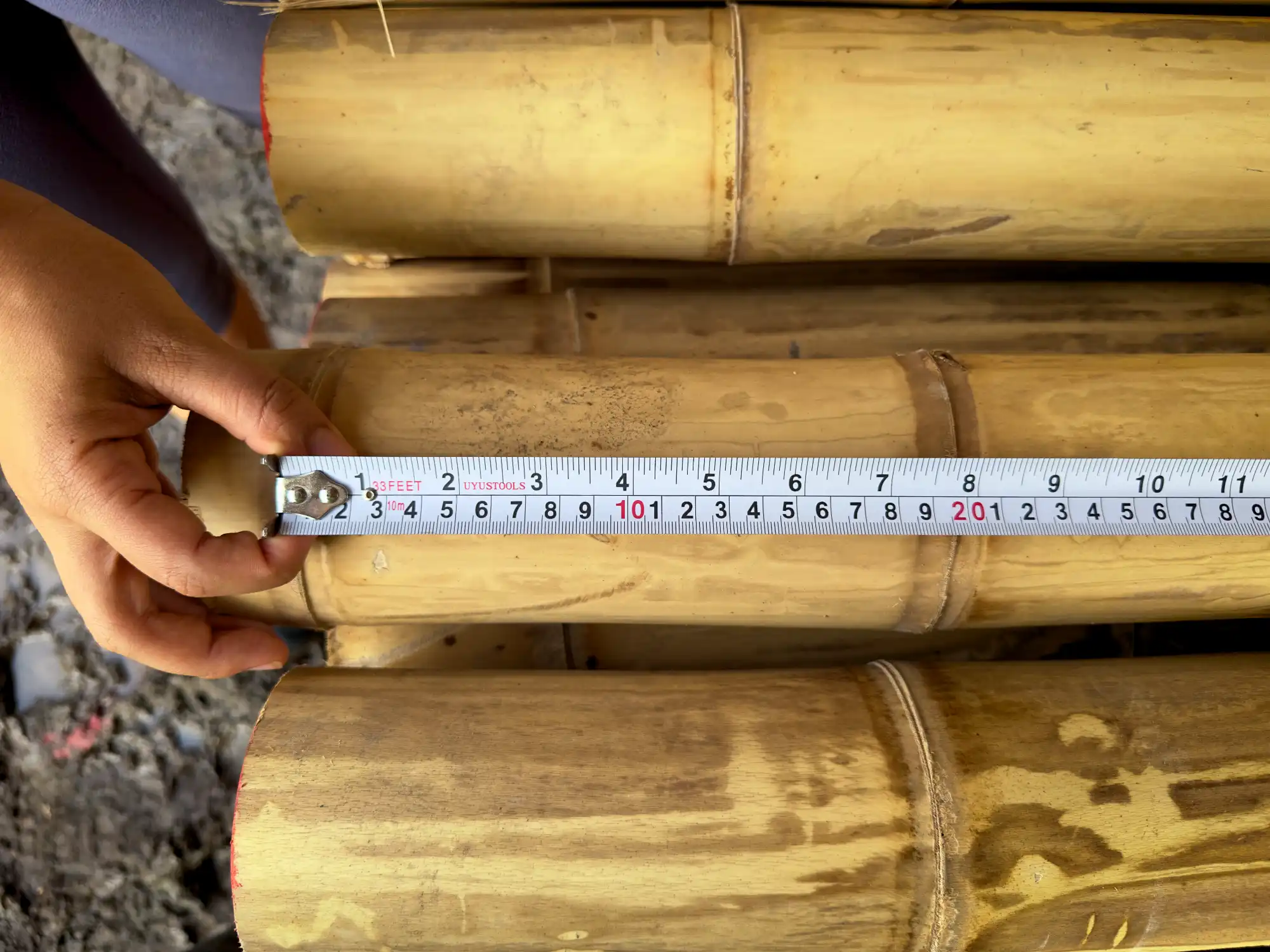
Wall thickness has a relatively small effect on flexural capacity and stiffness but is critical to shear and tension resistance. It must always be measured at the center of an internode, away from a node, to avoid distorted readings. Nodes play a role in preventing and containing splits and buckling, so poles with very long internode lengths may be unsuitable for certain structural applications.
For structural construction, we focus exclusively on poles extracted from the Bottom Section and Lower Middle Section of the culm.
Defining Culm Sections
Culm sections are defined by strict morphological thresholds developed as part of the Guadua Bamboo® Grading Standard. Our grading process takes into account the diameter, wall thickness, and internode length of each pole to determine its capacity to bear weight and resist external forces.
The following grading rules determine whether a pole was extracted from the structural sections of the culm.
Culm Section Classification and Grading Rules
| Diameter | Circumference | Min. wall thickness | Max. length of the first internode |
|---|---|---|---|
| 6 – 8 cm | 18.8 – 25.1 cm | 🔒 | 🔒 |
| 8 – 10 cm | 25.1 – 31.4 cm | 🔒 | 🔒 |
| 10 – 12 cm | 31.4 – 37.7 cm | 🔒 | 🔒 |
| 12 – 14 cm | 37.7 – 44.0 cm | 🔒 | 🔒 |
| 14 – 16 cm | 44.1 – 50.3 cm | 🔒 | 🔒 |
| > 16 cm | > 50.3 cm | 🔒 | 🔒 |
* This technical data is reserved for our commercial partners. If you are already a partner, please log in here to view the full specifications. If you would like to access our professional resources, please request access here.
Yield note: The Bottom Section represents the highest density and wall thickness in the culm, typically yielding a 1:3 ratio relative to the Lower Middle Section in a standard premium harvest batch.
Inspection Process
To guarantee compliance with the Guadua Bamboo® Grading Standard, our quality control follows a strict physical measurement protocol before any pole leaves our facility:
- Diameter and circumference check: Calipers and tape measures verify the external diameter and circumference at the thickest end of the pole to confirm the correct diameter class.
- 4-point wall thickness measurement: We measure average wall thickness at four points around the circumference at 90° intervals, always at the center of the thickest internode, away from any node.
- Basal internode measurement: We measure the length of the first (bottom) internode to verify it does not exceed the maximum allowable threshold for its diameter class.
- Traceability mapping: Based on our extensive knowledge of Guadua angustifolia morphology, we can determine with high precision from which section of the culm each pole was extracted and mark it accordingly.
Choosing the Right Culm Section
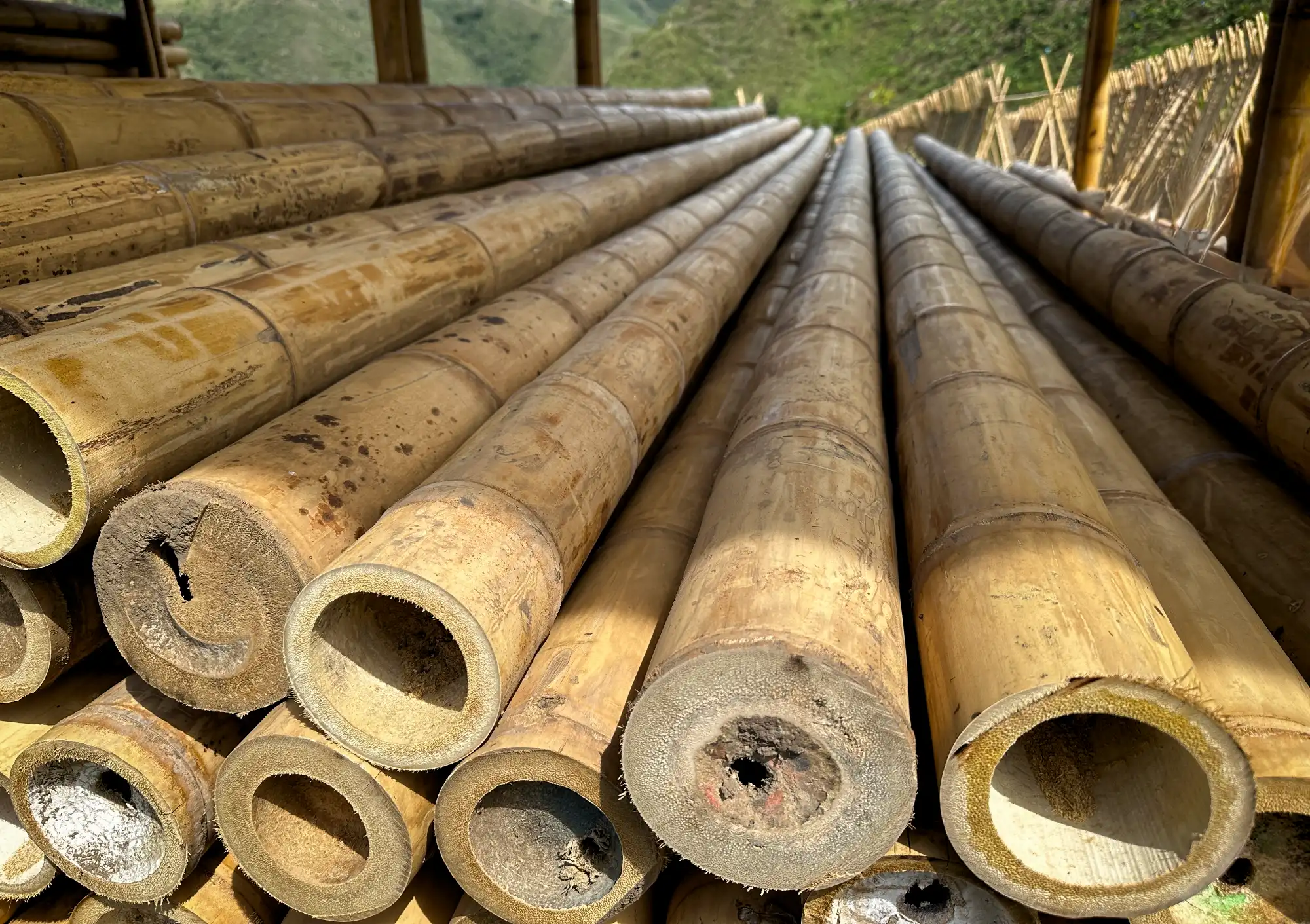
When ordering bamboo for structural or architectural applications, it is important to choose by culm section rather than generic bamboo poles. Each section has a different structural profile suited to different applications. For construction-related applications, we only focus on producing poles from the Bottom and Lower Middle sections of the culm. Our standard Grade A stock always complies with these sections.
- Bottom Section: Mandatory for foundation columns, ground posts, and heavily loaded structural connections where maximum wall thickness is critical to resist shear, splitting, and compression.
- Lower Middle Section: Ideal for main structural beams, trusses, rafters, and structural framing where uniform diameter, straight runs, and a balanced density-to-weight ratio are required.
- Upper Middle Section: For non-critical applications such as purlins or lighter architectural framing. Because this section tapers more steeply than the Bottom and Lower Middle sections, it is not held in our standard stock and is better suited for applications where dimensional consistency along the pole is less critical.
- Top Section: Best suited for non-structural applications such as cladding, fencing, screens, decorative panels, and shading elements where strength requirements are minimal and visual character is the primary consideration.
Never mix culm sections indiscriminately in structural blueprints. Designing with the correct wall thickness profiles ensures your bamboo structure meets safety requirements and performs reliably over its full service life.
If you have questions about culm section specifications for your project, contact our technical team.
Bamboo Grading Criteria
Explore all the technical assessment factors used in our Guadua Bamboo® Grading Standard to ensure structural quality.