
Taper & Conicity
Guadua Bamboo® Grading Standards
Understanding Bamboo Taper and Conicity
In bamboo construction, taper is the rate at which a culm’s diameter decreases from base to apex. It is a natural characteristic of all bamboo species, but the degree of taper varies significantly between them. Guadua angustifolia is known for its naturally low taper, particularly in the lower and middle sections of the culm, which is one of the reasons it performs so well as a structural material. The upper section of the culm tapers more steeply and is not used in structural construction.
Why Taper Matters
We grade for taper to provide a consistent benchmark for the following structural and design requirements:
- Structural Integrity: Taper reduces the effective load-bearing capacity along the length of a pole. A column or beam with significant taper has a smaller section at the top than the base diameter suggests, which reduces its actual bending and compression capacity. Grading for taper ensures that structural calculations reflect what the pole can actually deliver.
- Connection Precision: Low-taper poles fit more predictably in mechanical joints and prefabricated connector systems. Excessive taper creates misalignment in fixed-diameter sockets and increases fabrication time on site.
- Visual Uniformity: In exposed structural or architectural applications, taper affects the visual rhythm of columns and beams. Grade A poles provide tight dimensional consistency for projects where appearance matters alongside performance.
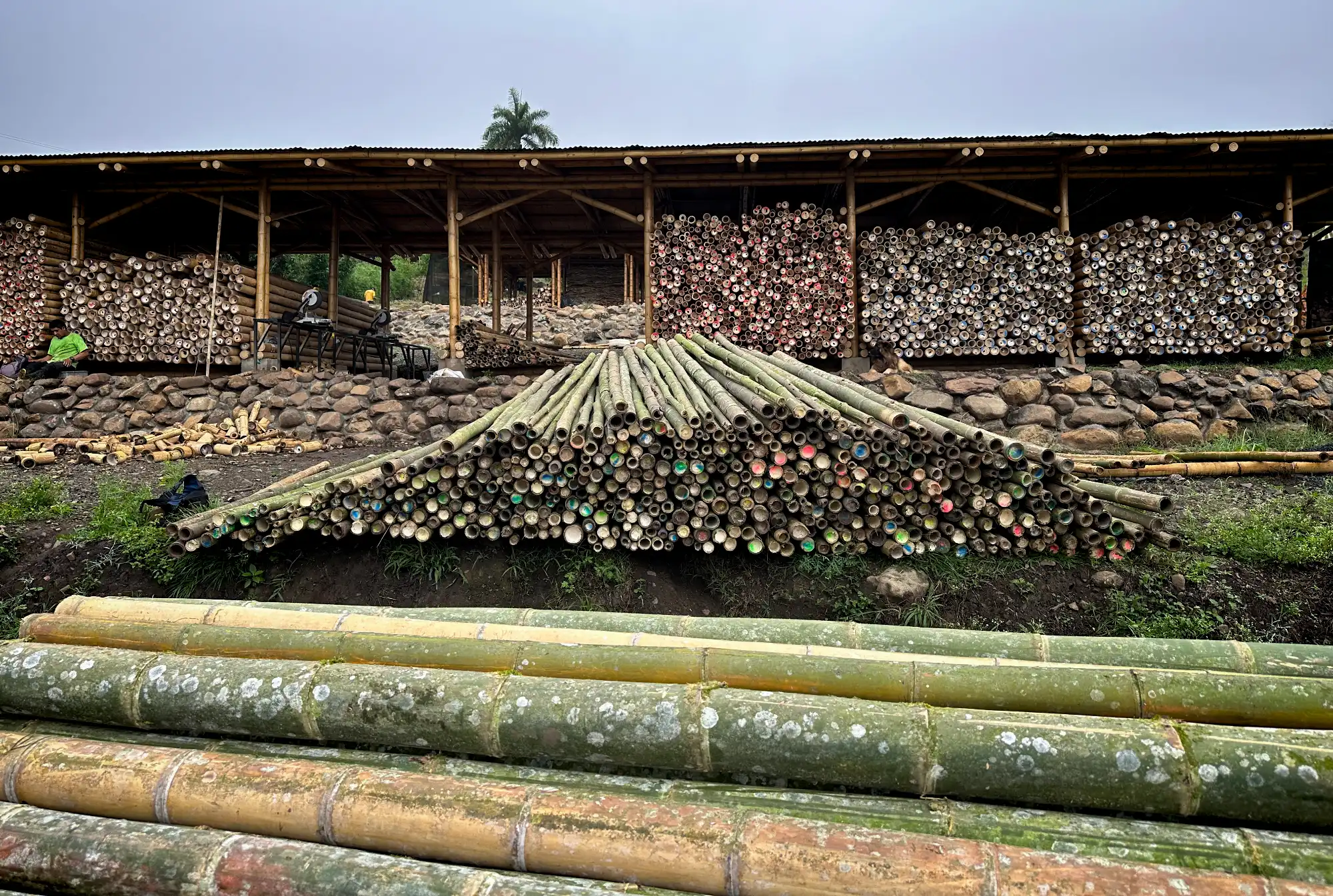
Defining Taper and Conicity
Taper is the difference in diameter between the base and the apex of a pole, expressed as a percentage of the pole’s total length.
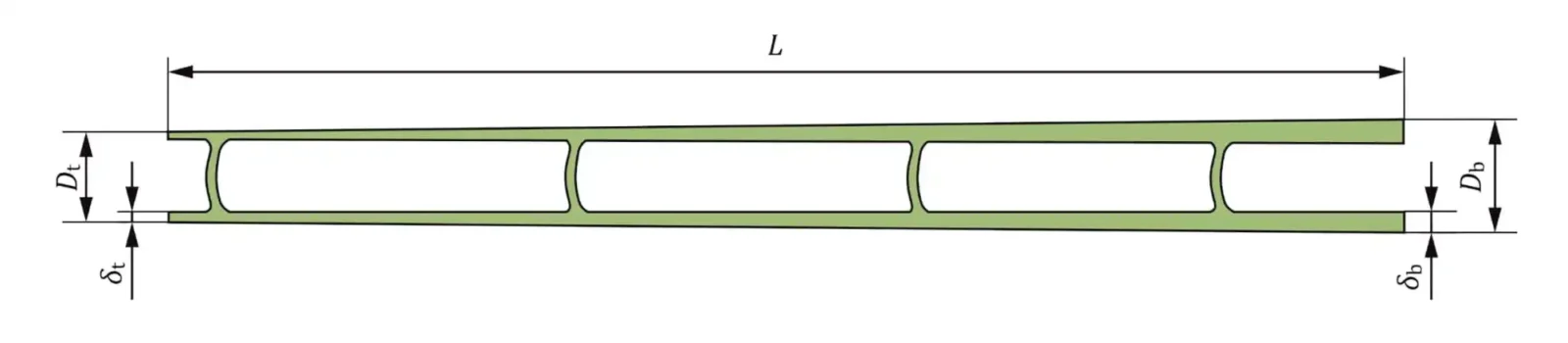
Key variables:
Db = diameter at the base of the pole
Dt = diameter at the top of the pole
L = length of the pole
δb = wall thickness at the base of the pole
δt = wall thickness at the top of the pole
Mathematical Standards (ISO 22156):
The external taper (αe) is calculated as: $$\alpha_{e} = \frac{D_{b} – D_{t}}{L}$$
For advanced engineering and mechanical modeling, the internal taper (αi) is calculated as:: $$\alpha_{i} = \frac{D_{b} – D_{t} – 2(\delta_{b} – \delta_{t})}{L}$$
A typical 6 m Guadua angustifolia pole extracted from the bottom or middle section of the culm has an average external taper of approximately 2 cm. This low, predictable taper is one of the structural advantages of Guadua over other bamboo species.
Taper Classification
We classify poles into 4 grades based on their external taper percentage. The specific threshold values are part of the proprietary Guadua Bamboo® Grading Standard, available to registered members.
| Taper | Grade | Range |
|---|---|---|
| Minimal | A+ | 🔒 |
| Normal | A | 🔒 |
| Medium | B | 🔒 |
| High | C | 🔒 |
* This technical data is reserved for our commercial partners. If you are already a partner, please log in here to view the full specifications. If you would like to access our professional resources, please request access here.
Grading Rules for External Taper
The tolerance table below translates taper percentages into maximum allowable diameter differences in centimetres for each standard pole length. This is what our graders measure on every pole before it enters stock.
Poles classified as Grade C are excluded from structural applications and are not supplied.
| Length | Minimal Taper (Grade A+) | Normal Taper (Grade A) | Medium Taper (Grade B) | High Taper (Grade C) |
|---|---|---|---|---|
| 150 cm | 🔒 | 🔒 | 🔒 | 🔒 |
| 300 cm | 🔒 | 🔒 | 🔒 | 🔒 |
| 450 cm | 🔒 | 🔒 | 🔒 | 🔒 |
| 600 cm | 🔒 | 🔒 | 🔒 | 🔒 |
| 750 cm | 🔒 | 🔒 | 🔒 | 🔒 |
| 900 cm | 🔒 | 🔒 | 🔒 | 🔒 |
* This technical data is reserved for our commercial partners. If you are already a partner, please log in here to view the full specifications. If you would like to access our professional resources, please request access here.
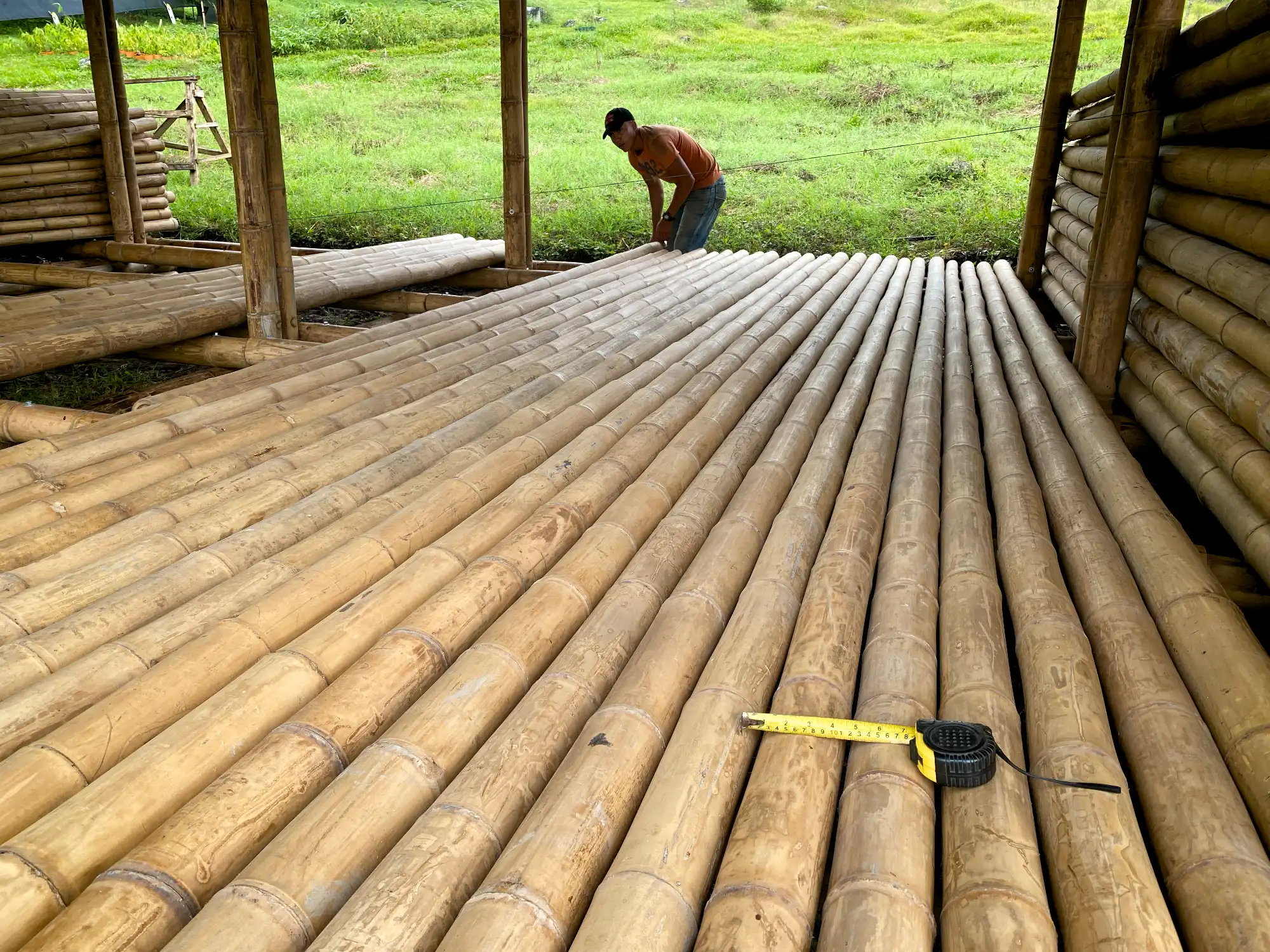
Taper Inspection Process
Every pole is measured individually before it leaves our facility in Colombia.
- Diameter measurement: We measure the external diameter at both the base and the apex of the pole.
- Taper calculation: The diameter difference is divided by the pole length to express taper as a percentage.
- Classification: The result is assigned to the corresponding grade. Poles meeting Grade A or better enter stock. Poles above that threshold are downgraded to B or rejected as Grade C.
Taper and Your Project
Our standard export stock is Grade A. Every pole in a standard container meets the normal taper specification as a minimum.
Grade A+ is available on request for projects requiring the tightest dimensional consistency: prefabricated structural systems with fixed connector tolerances, precision joinery, or architectural applications where column uniformity is part of the design intent. A+ selection carries a surcharge reflecting the higher rejection rate during sorting.
If your project has specific taper requirements, contact us with the specification and we will advise on feasibility, lead time, and pricing.
Bamboo Grading Criteria
Explore all the technical assessment factors used in our Guadua Bamboo® Grading Standard to ensure structural quality.