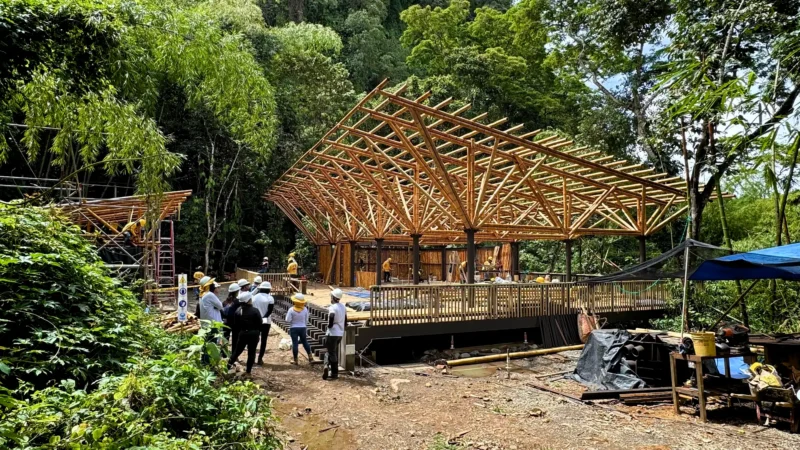

In modern architecture, a bamboo culm is no longer treated as an unpredictable organic element. For the purposes of precise structural calculation, Guadua is classified as homogeneous and linear, allowing engineers to apply the principles of classical structural mechanics in the same way as with steel or timber.
However, as a biological material, bamboo requires rigorous safety factors to account for natural variability. This is where Guadua bamboo design values become essential, translating raw test data into reliable parameters for engineering use. This article provides the mathematical constants and formulas required to transform Guadua bamboo poles into a predictable, high-performance structural material, in accordance with the Colombian Building Code (NSR-10).
Quick Technical Reference
- Bending Strength (Fb): 15 MPa
- Parallel Compression (Fc): 14 MPa
- Shear Strength (Fv): 1.2 MPa
- Modulus of Elasticity (E0.5): 9,500 MPa
- Standard Moisture Content: 12%
Note on Design Values:
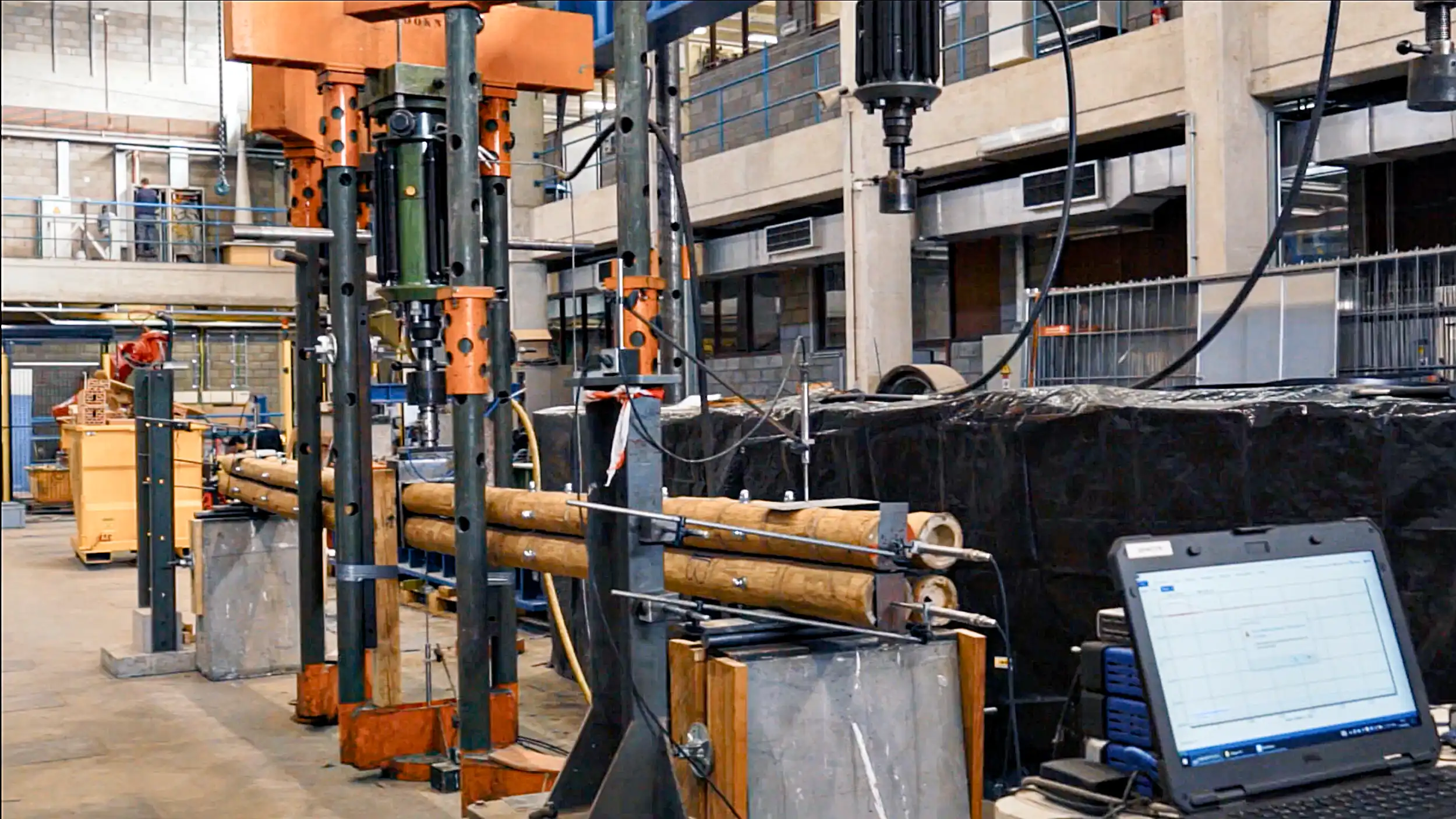
- These figures represent Allowable Stress Design (ASD) values according to the Colombian Building Code NSR-10, not ultimate failure limits. While laboratory tests may show Guadua reaching an ultimate bending strength of 74 MPa or higher, the building code applies a combined reduction factor (Safety, Duration, and Condition) to ensure a massive safety buffer for real-world construction.
- All design values assume compliance with NSR-10 quality and grading criteria. Refer to our Structural Guadua Bamboo Quality Requirements for material selection standards.
1. The Structural Design Method
A bamboo structure is a system designed to resist specific service loads and environmental conditions. To ensure structural integrity, the following requirements must be met:
- Load & Deflection: All elements and joints must be designed to resist the stresses produced by service load combinations and comply with official deflection limits.
- Structural Systems: Every construction must adhere to standardized types defined for seismic and load resistance, such as frames or load-bearing walls.
- Professional Oversight: Structures must be designed by qualified professionals and built by trained personnel under expert direction.
- Seismic Design: For seismic-resistant systems using bamboo frames with diagonals, a basic energy dissipation coefficient (R0) of 2.0 is applied.
- Lifecycle Maintenance: Adequate preventive maintenance is mandatory to prevent attack by insects or fungi throughout its service life.
- Environmental Sensitivity: Design analysis must reflect all possible loads during construction and service, including environmental factors like humidity or chemical exposure (e.g., chlorine in pool covers or enclosures).
2. The Measurement Standard for Precision Engineering
Structural precision depends on how the material is measured. To determine the “real” diameter and thickness for structural formulas, a single-point measurement is insufficient. We utilize a specific averaging process to ensure accuracy:
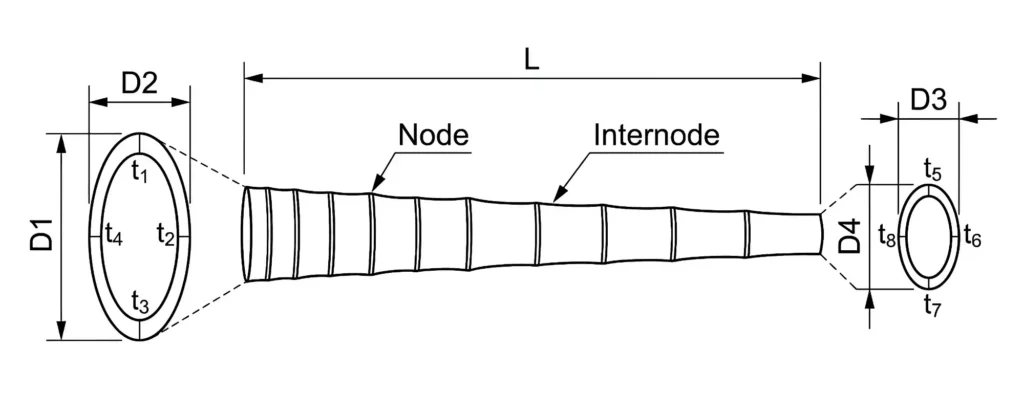
- Real Diameter (D): Measured at both ends of the segment in 2 perpendicular directions. The real diameter is the average of these 4 measurements.
- Real Thickness (t): 4 measurements are taken at each end in the same locations as the diameter. The real thickness is the average of these 8 measurements.
3. The Method of Allowable Stresses (ASD)
We utilize the Allowable Stress Design (ASD) method. This process takes laboratory failure data and applies significant reductions to ensure a massive safety margin for real-world construction conditions. All values are standardized at 12% Moisture Content.
Base Allowable Stresses (MPa)
| Property | Symbol | Value (MPa) |
|---|---|---|
| Bending (Flexural) | Fb | 15 |
| Tension | Ft | 18 |
| Parallel Compression | Fc | 14 |
| Perpendicular Compression* | Fp | 1.4 |
| Shear | Fv | 1.2 |
Note: Perpendicular Compression (Fp) refers specifically to internodes reinforced with cement mortar.
Modulus of Elasticity (MPa)
| Description | Symbol | Value (MPa) |
|---|---|---|
| Average Modulus | E0.5 | 9,500 |
| 5th Percentile Modulus | E0.05 | 7,500 |
| Minimum Modulus | Emin | 4,000 |
Note: Use E0.5 for general analysis, but Emin is mandatory for calculating the stability coefficients of columns and beams.
4. The “Safety” Behind the Numbers
The code applies strict reduction factors to laboratory “characteristic values” to account for the variables of a real-world construction site versus a controlled lab environment. This ensures that the Structural Guadua you use has a significant built-in buffer for safety.
Reduction Factors
These factors are already baked into the Base Allowable Stresses mentioned above, but are critical for understanding the material’s conservative design limits.
| Factor | Bending | Tension | Parallel Compression | Perpendicular Compression | Shear |
|---|---|---|---|---|---|
| Condition Factor (Fc) | – | 0.5 | – | – | 0.6 |
| Safety Factor (Fs) | 2.0 | 2.0 | 1.5 | 1.8 | 1.8 |
| Duration of Load (CD) | 1.5 | 1.5 | 1.2 | 1.2 | 1.1 |
5. Adjustment Factors for Design Values
The actual strength of a bamboo member is not a fixed number; it is a calculation. We determine the Modified Allowable Stress (F’) by taking the “base strength” of the bamboo and adjusting it for its physical condition and its final environment.
The Formula
To get the final result, we multiply the base stress by several specific adjustment factors:
Definitions
- F′i: Adjusted allowable stress for the property i
- Fi: Reference allowable stress for the property i
- CD: Modification coefficient for load duration
- Cm: Modification coefficient for moisture content
- Ct: Modification coefficient for temperature
- CL: Modification coefficient for lateral stability of beams
- CF: Modification coefficient for form (shape)
- Cr: Modification coefficient for redistribution of loads/joint action
- Cp: Modification coefficient for column stability
- Cc: Modification coefficient for shear
What we are adjusting for:
- Material Quality: We first select the base stress (Fi) by looking at the size, the nodes, and the presence of any cracks in the Guadua.
- Environment: We then apply factors for Load Duration (CD), Moisture (Cm), and Temperature (Ct).
- Engineering Design: Finally, we adjust for how the bamboo will behave mechanically, such as Column Stability (Cp) to prevent buckling and Shear (Cc) for the joints.
A. Load Duration Adjustments (CD)
According to the Colombian Building Code NSR-10, the reference values for allowable stress are based on a normal load duration of 10 years. When structural elements are subjected to different load durations, the values from the Base Allowable Stresses must be multiplied by the coefficients in the table below.
| Duration of Load (CD) | Bending | Tension | Parallel Compression | Perpendicular Compression | Shear | Design Load |
|---|---|---|---|---|---|---|
| Permanent | 0.90 | 0.90 | 0.90 | 0.90 | 0.90 | Dead Load |
| 10 Years | 1.00 | 1.00 | 1.00 | 0.90 | 1.00 | Live Load |
| 2 Months | 1.15 | 1.15 | 1.15 | 0.90 | 1.15 | Construction |
| 7 Days | 1.25 | 1.25 | 1.25 | 0.90 | 1.25 | Construction |
| 10 Minutes | 1.60 | 1.60 | 1.60 | 0.90 | 1.60 | Wind & Seismic |
| Impact | 2.00 | 2.00 | 2.00 | 0.90 | 2.00 | Impact |
Key implementation rules from the code:
- Non-Cumulative: These adjustment factors are not cumulative.
- Load Combinations: When multiple types of loads are combined, the element must be dimensioned based on the most unfavorable condition.
B. Moisture Content Adjustments (Cm)
Like timber, Guadua loses strength and stiffness as its moisture content increases. The reference allowable stresses and elasticity modules are based on a standard moisture content of 12%. If site conditions cause the moisture content to rise above this 12% baseline, the values must be adjusted by multiplying them by the coefficients found in the table below.
| Stress Type | Symbol | MC ≤ 12% | MC = 13% | MC = 14% | MC = 15% | MC = 16% | MC = 17% | MC = 18% | MC ≥ 19% |
|---|---|---|---|---|---|---|---|---|---|
| Bending | Fb | 1.0 | 0.96 | 0.91 | 0.87 | 0.83 | 0.79 | 0.74 | 0.70 |
| Tension | Ft | 1.0 | 0.97 | 0.94 | 0.91 | 0.89 | 0.86 | 0.83 | 0.80 |
| Parallel Compression | Fc | 1.0 | 0.96 | 0.91 | 0.87 | 0.83 | 0.79 | 0.74 | 0.70 |
| Perpendicular Compression | Fp | 1.0 | 0.97 | 0.94 | 0.91 | 0.89 | 0.86 | 0.83 | 0.80 |
| Shear | Fv | 1.0 | 0.97 | 0.94 | 0.91 | 0.89 | 0.86 | 0.83 | 0.80 |
| Modulus of Elasticity | E | 1.0 | 0.99 | 0.97 | 0.96 | 0.94 | 0.93 | 0.91 | 0.90 |
C. Temperature Adjustments (Ct)
When structural bamboo elements are exposed to high temperatures, the allowable stress values and elasticity modules must be multiplied by the factors in table below to account for the specific thermal conditions of the site.
| Stress Type | Symbol | Service Condition | T ≤ 37°C | 37°C ≤ T ≤ 52°C | 52°C ≤ T ≤ 65°C |
|---|---|---|---|---|---|
| Bending | Fb | Wet | 1.0 | 0.60 | 0.40 |
| Dry | 1.0 | 0.85 | 0.60 | ||
| Tension | Ft | Wet | 1.0 | 0.85 | 0.80 |
| Dry | 1.0 | 0.90 | 0.80 | ||
| Parallel Compression | Fc | Wet | 1.0 | 0.65 | 0.40 |
| Dry | 1.0 | 0.80 | 0.60 | ||
| Perpendicular Compression | Fp | Wet | 1.0 | 0.80 | 0.50 |
| Dry | 1.0 | 0.90 | 0.70 | ||
| Shear | Fv | Wet | 1.0 | 0.65 | 0.40 |
| Dry | 1.0 | 0.80 | 0.60 | ||
| Modulus of Elasticity | E | Wet | 1.0 | 0.80 | 0.80 |
| Dry | 1.0 | 0.90 | 0.80 |
6. Fundamental Design Assumptions
For structural modeling, we adhere to 2 vital rules that ensure project safety:
- Pinned Joints: All connections are technically considered pinned. There is no transmission of moments between elements unless an element is continuous.
- Action in Unison (Cr): Allowable stresses can be increased by 10% (Cr=1.1) when using 4 or more elements of equal stiffness spaced no more than 60 cm apart.
The Bottom Line: Engineering with Technical Certainty
Professional building is about moving from “craftsmanship” to structural engineering. By utilizing these standardized MPa values and reduction factors, engineers can ensure predictable performance and safety through science.
- Predictable Performance: By using the ASD (Allowable Stress Design) method and the MPa values, your engineer can calculate exact load capacities for every beam and column.
- Safety Through Science: The code’s strict Reduction Factors (Fs) and Modification Coefficients (Ci) ensure that the structure is over-engineered to survive the real-world stresses of wind, seismic activity, and time.
- Physical Integrity: At Guadua Bamboo, our focus is on providing material that matches these exact mathematical models. We prioritize a controlled, natural curing process to ensure every culm retains the natural elasticity and structural health required for high-performance architecture.