
Curvature & Straightness
Guadua Bamboo® Grading Standards
Understanding Bamboo Curvature and Straightness
In structural bamboo construction, the straightness of a pole is a critical factor in how it carries weight and how it connects to other structural members. While bamboo is a natural material and is rarely perfectly straight, we grade for curvature to ensure your project receives the material reliability required for load-bearing applications. Grading transforms an inherent natural characteristic into a documented, manageable specification.
Why Straightness Matters
We grade for curvature to provide a consistent benchmark for the following structural requirements:
- Structural Integrity: Columns that deviate from their vertical axis generate secondary bending stresses under load, which reduces their effective compression capacity and must be accounted for in structural calculations.
- Connection Precision: Straight poles seat more predictably in bolted, pinned, or lashed connections, reducing fabrication complexity and improving joint reliability. For prefabricated systems with fixed connector tolerances, curvature limits are especially critical.
- Labor Efficiency: Predictable pole geometry means less on-site adjustment, faster assembly, and fewer surprises for your construction crew.
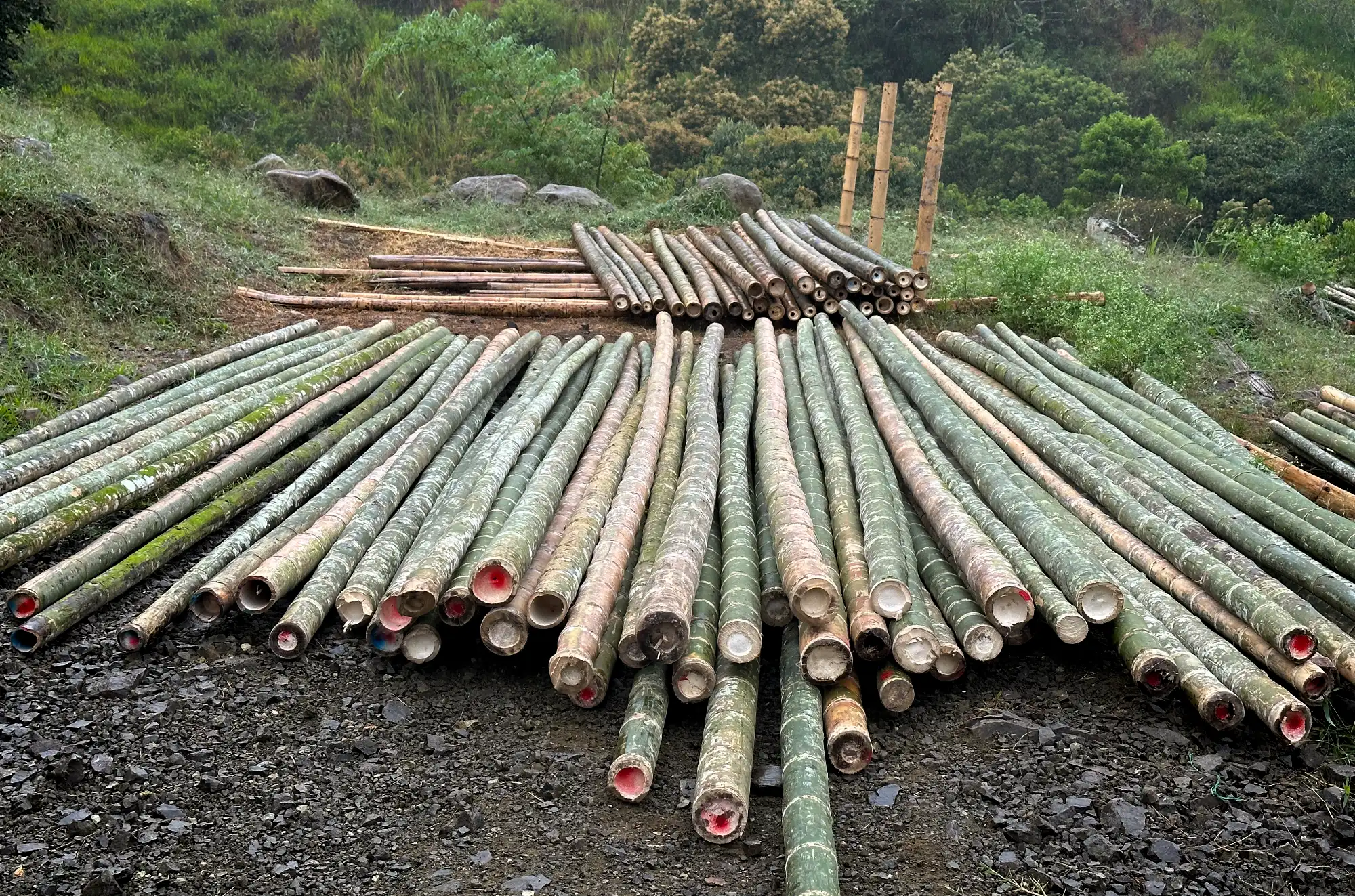
Defining Curvature and Straightness
The curvature of a culm is determined by measuring the greatest perpendicular deviation of its axis from a straight reference line drawn between the two ends of the pole. When a pole has more than one curve along its length, the individual deviations are measured and added together to calculate the total bow.
The result is expressed as a percentage of the pole length. This single value is what determines the grade.

bmax = maximum perpendicular distance from the centre of the culm section to the chord drawn from the centers of either end of the piece.
Lref = reference length of the piece.
Curvature Classification
We classify curvature into four ranges that map directly to our four grades. The specific threshold values are part of the proprietary Guadua Bamboo® Grading Standard, available to registered members.
| Curvature | Grade | Range |
|---|---|---|
| Minimal | A+ | 🔒 |
| Normal | A | 🔒 |
| Medium | B | 🔒 |
| High | C | 🔒 |
* This technical data is reserved for our commercial partners. If you are already a partner, please log in here to view the full specifications. If you would like to access our professional resources, please request access here.
Grading Rules for Curvature
The tolerance table below translates curvature percentages into maximum allowable deviation values in centimetres for each standard pole length. This is what our graders measure physically on every pole before it enters stock.
Poles classified as Grade C are excluded from structural applications and are not supplied.
| Length | Minimal Curvature (Grade A+) | Normal Curvature (Grade A) | Medium Curvature (Grade B) | High Curvature (Grade C) |
|---|---|---|---|---|
| 150 cm | 🔒 | 🔒 | 🔒 | 🔒 |
| 300 cm | 🔒 | 🔒 | 🔒 | 🔒 |
| 450 cm | 🔒 | 🔒 | 🔒 | 🔒 |
| 600 cm | 🔒 | 🔒 | 🔒 | 🔒 |
| 750 cm | 🔒 | 🔒 | 🔒 | 🔒 |
| 900 cm | 🔒 | 🔒 | 🔒 | 🔒 |
* This technical data is reserved for our commercial partners. If you are already a partner, please log in here to view the full specifications. If you would like to access our professional resources, please request access here.
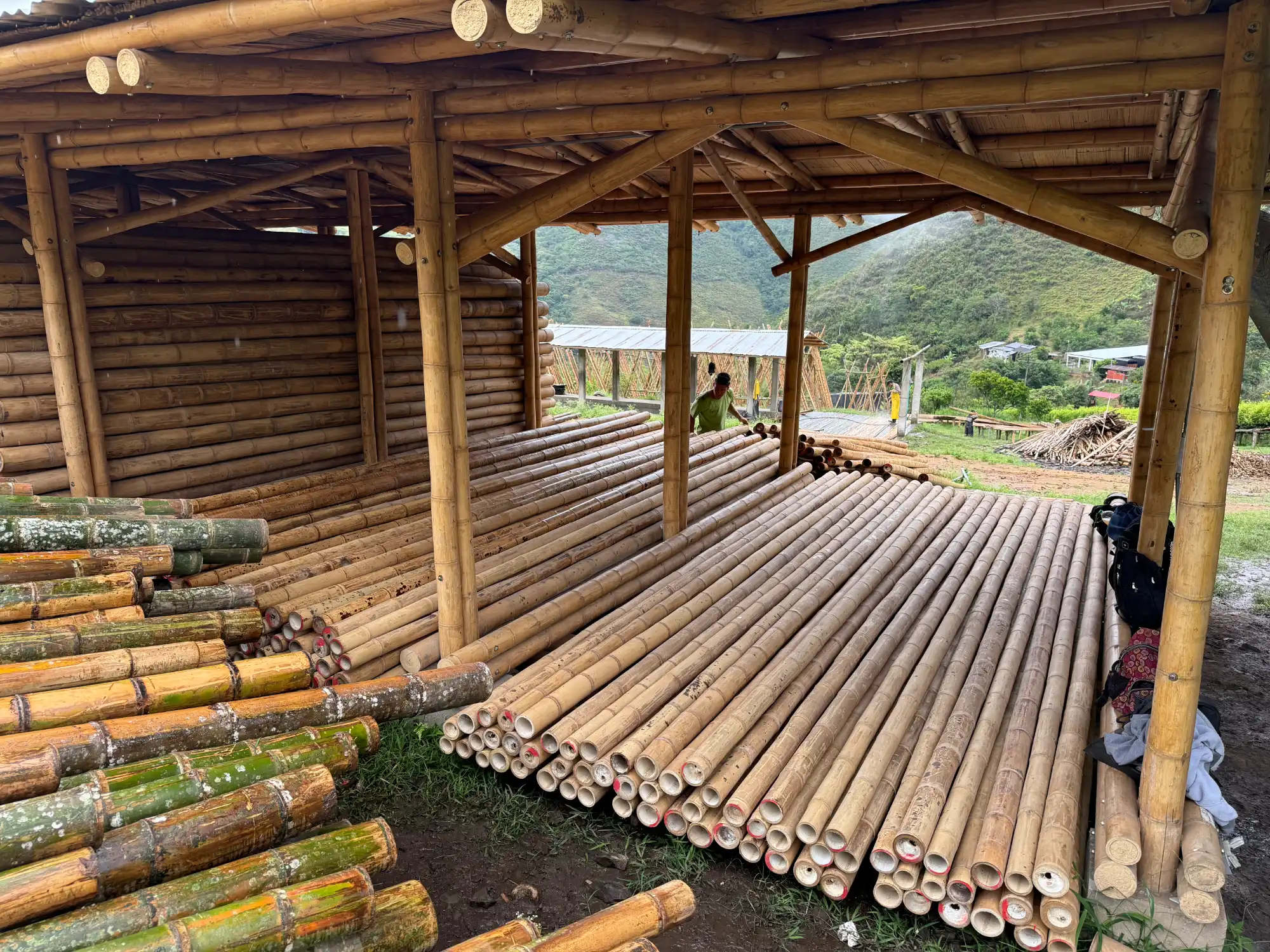
Curvature Inspection Process
We do not rely on estimates or batch sampling. Every pole is measured individually before it leaves our facility in Colombia.
- Alignment Check: The pole is placed on a flat reference surface and rotated 360° to identify the point of maximum deviation from straight.
- Measurement: The greatest perpendicular distance between the pole axis and the reference line is measured at that point. For poles with multiple curves, each deviation is measured and summed.
- Classification: The total deviation is expressed as a percentage of pole length and assigned to the corresponding grade. Poles meeting Grade A or better enter stock. Poles above that threshold are downgraded to B or rejected as Grade C.
Curvature and Your Project
Our standard export stock is Grade A. Every pole in a standard container meets the Normal Curvature specification as a minimum.
Grade A+ is available on request for projects with tighter straightness requirements: exposed architectural applications, prefabricated structural systems, or connector systems with fixed geometric tolerances. A+ selection carries a surcharge reflecting the higher rejection rate during sorting.
If your project has specific curvature requirements, contact us with the specification and we will advise on feasibility, lead time, and pricing.
Bamboo Grading Criteria
Explore all the technical assessment factors used in our Guadua Bamboo® Grading Standard to ensure structural quality.