
External Diameters
Guadua Bamboo® Grading Standards
Understanding Bamboo Diameters
When designing or building with Guadua bamboo poles, understanding its physical dimensions is the starting point for any structural project. The average diameter of Guadua angustifolia is 11 cm, but smaller and larger diameter culms are commonly found inside a plantation. Every individual culm naturally tapers from its base to its canopy, meaning it does not maintain a perfectly uniform cylinder.
Because of this natural taper and the slightly oval shape of bamboo, measuring external diameter can be approached in different ways:
- Average diameter over pole length: The average of perpendicular measurements made across opposite points on the outer surface at both ends of the piece. For sections with a large taper, this method has the disadvantage that flexural capacity or buckling load may be overestimated.
- Smallest average diameter: The average value of two perpendicular measurements made across opposite points on the outer surface at the narrowest internode on the piece. This ensures the required diameter is met everywhere along the culm and is fast to execute, but on a more oval cross-section it can over- or underestimate flexural capacity.
- Smallest absolute diameter: The smallest measurement made across opposite points on the outer surface at the narrowest internode on the piece. This quick approach avoids concerns about ovality or taper, though some applications require ensuring pieces fall within a specific range.
In conclusion, every method has its trade-offs due to the natural taper and oval shape of bamboo.
Why Diameter Matters
Diameter is one of the most important considerations when grading for flexural properties. A 10% increase in external diameter results in a 24% increase in flexural capacity. The effect is even greater for flexural stiffness, where a 10% increase in diameter results in a 37% increase.
Because structural performance depends so heavily on this dimension, our grading process accounts for diameter, wall thickness, and internode length to determine a pole’s capacity to bear weight and resist external forces. For construction applications, we focus exclusively on poles from the bottom and lower middle sections of the culm.
The most abundant and commercially available culm diameters fall between 8 and 14 cm when measured at mid-pole. Poles outside this range exist but are difficult to source in large quantities, which is why we hold large permanent stock of these commercially common sizes. Our diameter classification applies strictly to dried and seasoned bamboo at 19% moisture content or less.
How We Measures External Diameters
Guadua angustifolia is a giant bamboo with fairly stable dimensional properties compared to other bamboo species. A 6 m long Guadua pole, extracted from the bottom or middle section of the culm, has an average taper of approximately 2 cm.
For the most accurate flexural calculations, the technically correct method is to measure the circumference at the middle of the pole and convert it to diameter. In practice, however, this is impractical at production scale. Poles are stored and transported in large horizontal stacks, where the middle of each pole is buried under dozens of others and physically inaccessible without unstacking the entire pile.
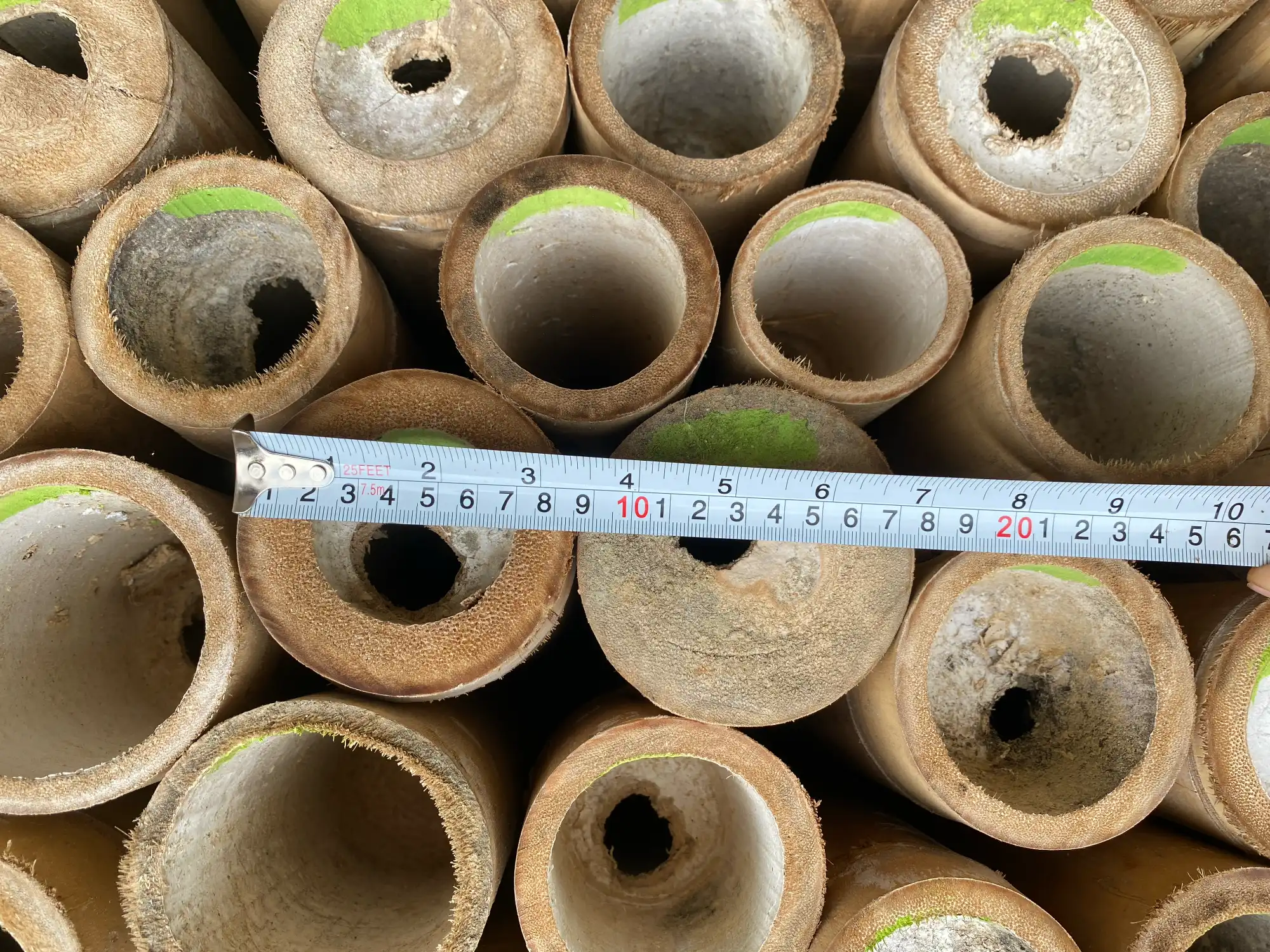
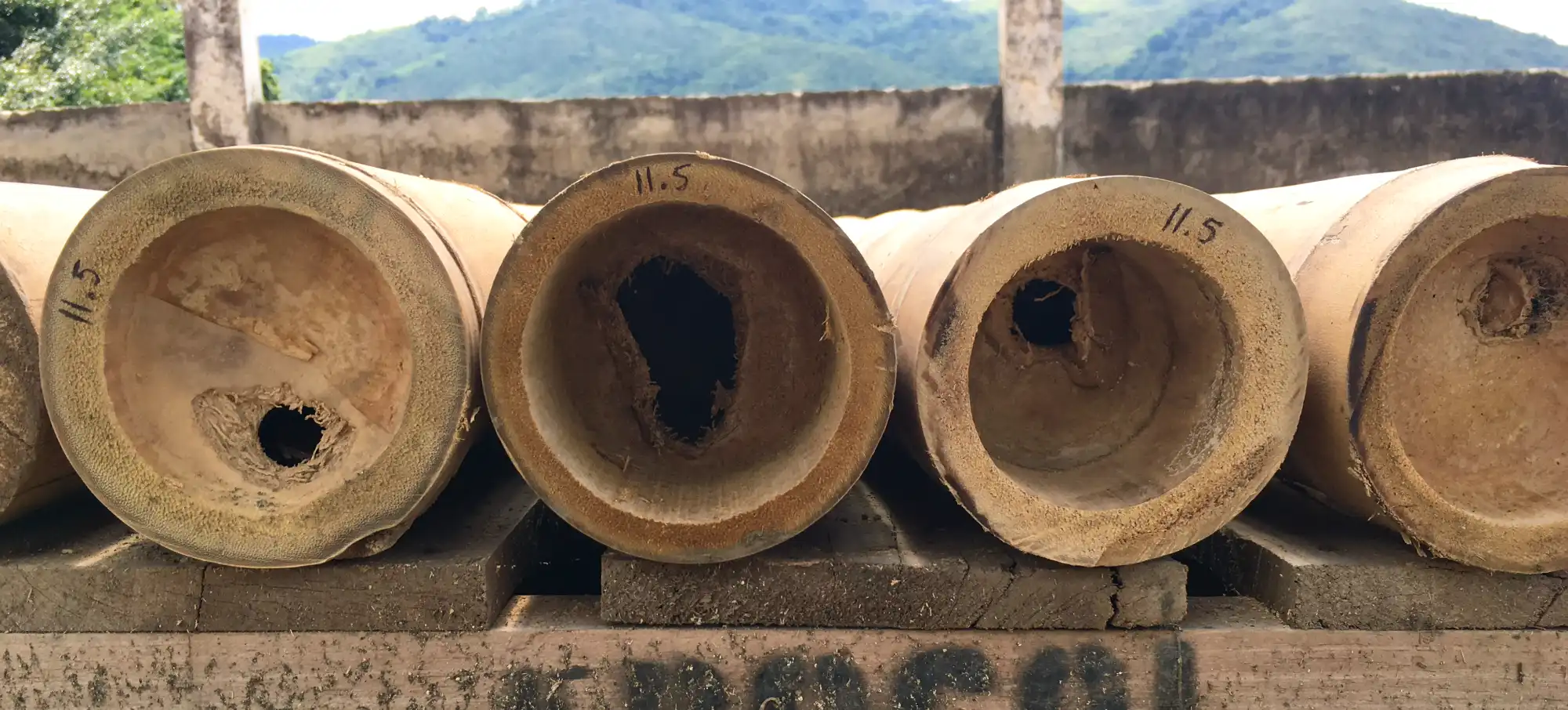
For this reason, the Guadua Bamboo® Grading Standard measures diameter at the base, the thickest end of the pole. This method is far more practical for our team and our clients to quickly verify the diameter of any individual pole, even deep within a stack. It also matters for clients who require a specific base diameter to fit poles into prefabricated joinery systems with a fixed socket diameter.
To calculate flexural properties based on our published base diameter, subtract 1 cm to estimate the average mid-pole diameter. For example, a 6 m pole classified as 9–11 cm at the base has an average mid-pole diameter of approximately 8–10 cm.
Diameter Classification
Our diameter classes bridge the gap between commercial practicality and strict engineering accuracy. The table below shows how our base diameter measurements correspond to the equivalent mid-pole diameter, which is the value used in flexural calculations.
| Base Diameter | Base Circumference | Mid-Pole Diameter | Mid-Pole Circumference |
|---|---|---|---|
| 7 – 9 cm | 22.0 – 28.3 cm | 6 – 8 cm | 18.8 – 25.1 cm |
| 9 – 11 cm | 28.3 – 34.6 cm | 8 – 10 cm | 25.1 – 31.4 cm |
| 11 – 13 cm | 34.6 – 40.8 cm | 10 – 12 cm | 31.4 – 37.7 cm |
| 13 – 15 cm | 40.8 – 47.1 cm | 12 – 14 cm | 37.7 – 44.0 cm |
Inspection Process
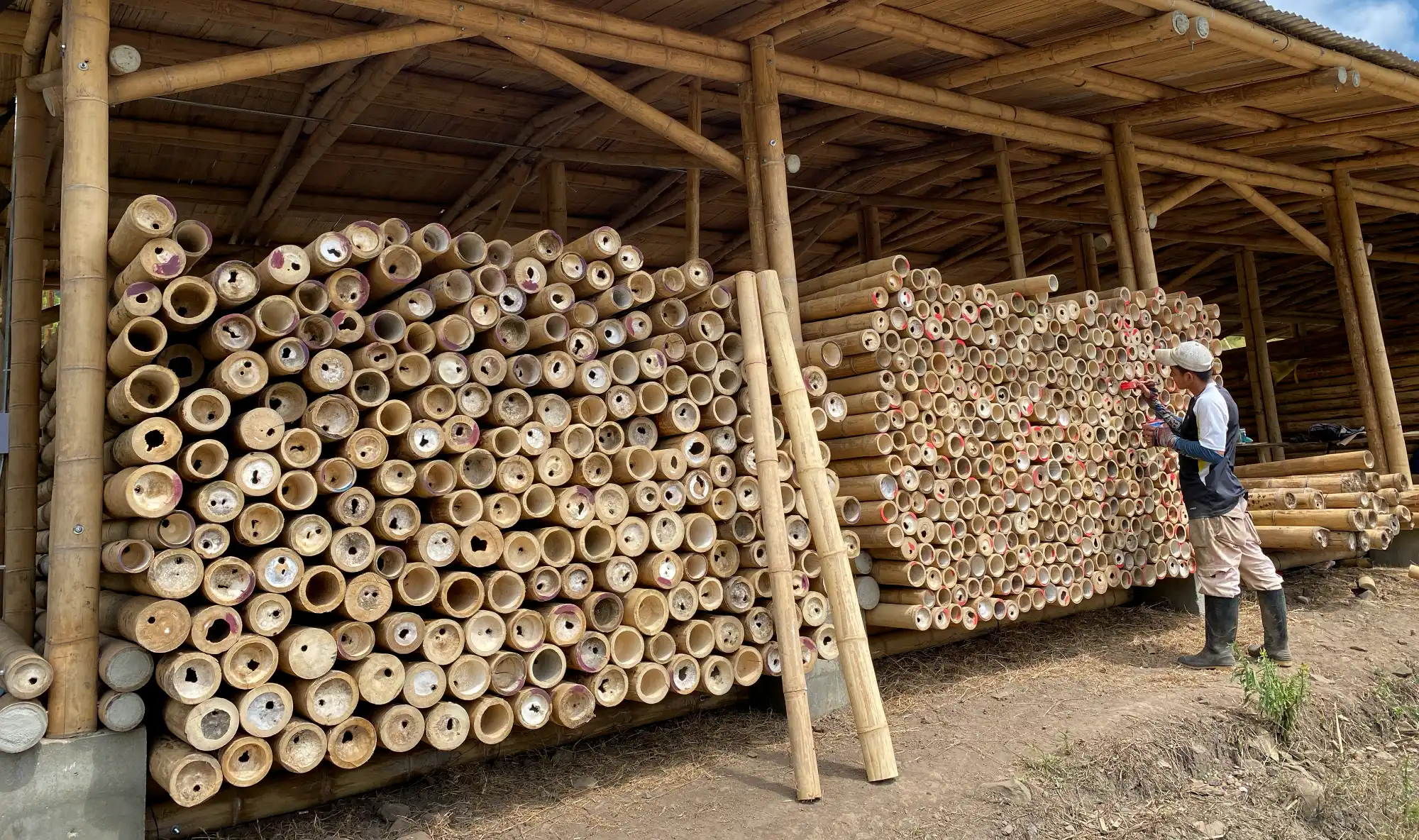
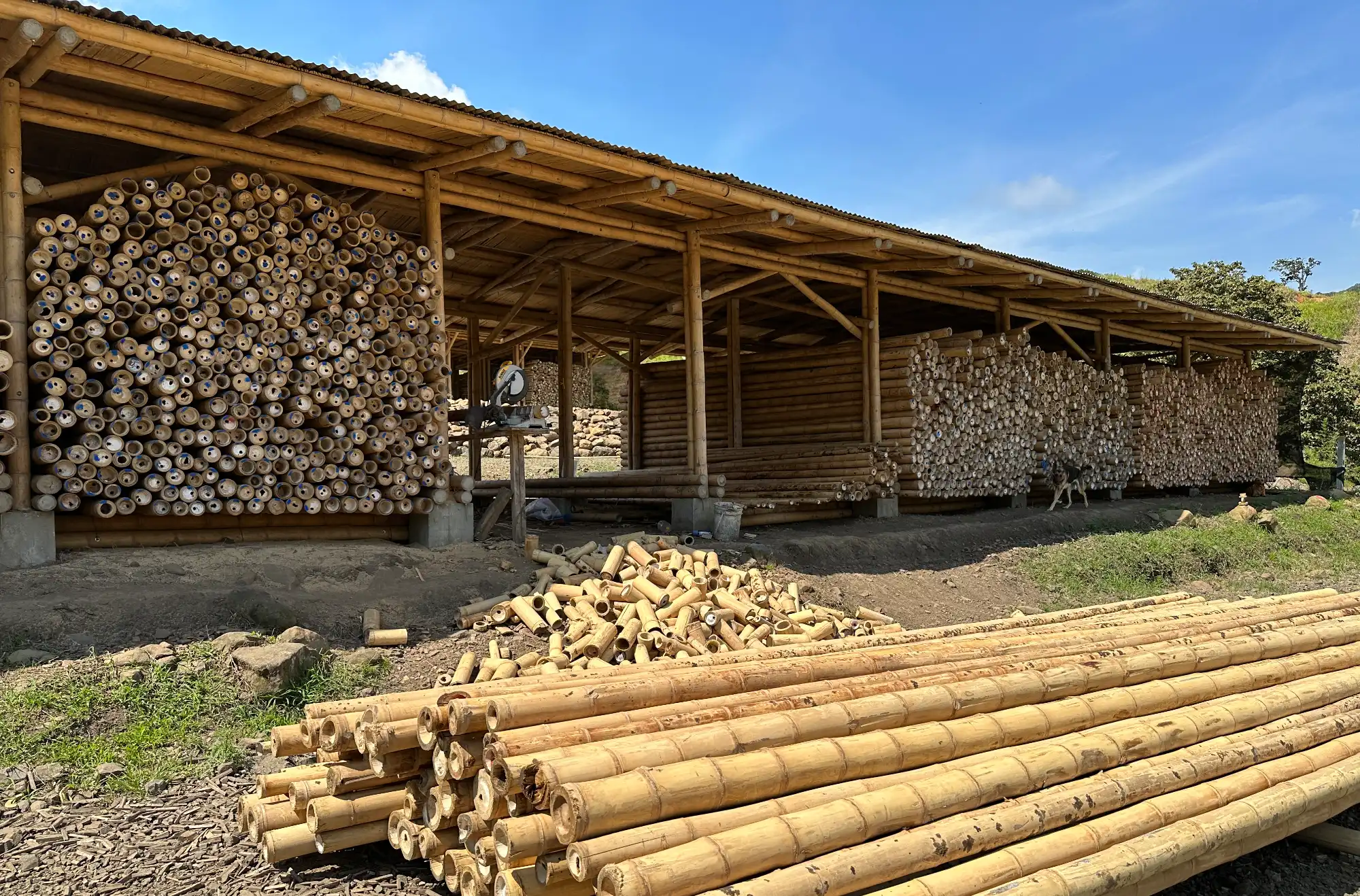
To ensure our dimensions align with architectural and structural requirements, every pole is measured individually and organized into separate stacks by diameter class.
- Base diameter sorting: Every pole is caliper-measured across two perpendicular points at the base to assign it to its commercial diameter class.
- Mid-pole estimation: For engineering calculations, the average mid-pole diameter is calculated by subtracting 1 cm from the base measurement.
- Moisture content verification: Before final dimensional classification, poles are tested with a moisture meter to confirm they have reached a stable, seasoned state of 19% moisture content or less.
Designing with Diameter Classes
When planning and drafting structural engineering layouts with Guadua, keep these diameter rules in mind:
- Subtract 1 cm for flexural calculations: For 6 m poles, subtract approximately 1 cm from the published base diameter when calculating flexural capacity and stiffness to estimate the mid-pole value used in structural design.
- Design around the mid-pole value: Use the mid-pole estimate, not the base diameter, when calculating buckling load or flexural capacity to avoid overestimating a column’s actual performance.
- Prioritize stock sizes: For cost efficiency and consistent lead times, design around our most abundant commercial diameters between 9 and 13 cm, rather than relying heavily on rare, oversized poles that are harder to source in volume.
If your project requires a specific diameter range or precise base tolerances, contact our technical team.
Bamboo Grading Criteria
Explore all the technical assessment factors used in our Guadua Bamboo® Grading Standard to ensure structural quality.