
Drying & Moisture Content
Guadua Bamboo® Grading Standards
Understanding Bamboo Moisture Content
Drying bamboo poles correctly is a critical step in producing structurally reliable Guadua bamboo, and it all comes down to controlling moisture content, the percentage of water in a culm relative to its fully dry weight. Because bamboo is a hygroscopic material, it continuously absorbs and releases moisture in response to its surrounding environment, even after the pole has fully seasoned. A freshly harvested pole holds the highest concentration of this moisture, typically 50% to 60% or more of its weight in water, depending on the felling season, growing region, and maturity.
As bamboo dries it contracts. This shrinkage begins the moment the pole is cut and can reduce pole diameter by 10% to 16% and wall thickness by 15% to 17% by the time the pole is fully seasoned. Drying bamboo also takes longer than drying wood of comparable density, typically 6 months from harvest to fully seasoned. Bamboo’s outer surface is protected by a hard, silica-rich layer that slows moisture loss, and the culm’s hollow structure with internal node walls restricts how water vapor moves through and escapes the material. This is why controlled, gradual drying matters more for bamboo than for most other structural materials.
Bamboo that has not been properly dried is unstable. It will continue to shrink and move after installation, which can loosen connections, distort structures, and create conditions for fungal decay. A pole is only considered seasoned once its moisture content has stabilized close to equilibrium with the surrounding climate, typically between 14% and 16% in our region.
Why Moisture Content Matters
Moisture content affects nearly every other structural property of a bamboo pole:
- Dimensional stability: Bamboo shrinks as it dries. A pole graded and installed while still wet will continue to shrink afterward, loosening bolted or lashed connections over time.
- Strength: Dry bamboo is significantly stronger than green bamboo. Testing structural values on unseasoned material overstates what the material can actually deliver once installed.
- Decay resistance: High moisture content combined with residual sugars makes green bamboo highly attractive to fungi and insects.
- Fissuring: Poles dried too quickly or unevenly are far more prone to splitting. Controlled, gradual drying is essential to keeping fissures within grade.
How We Dry and Season Our Bamboo
Every pole goes through the same controlled drying process before it is graded and shipped.
- Harvesting: Before harvest, standing culms in the plantation are checked at the node with a resistance-type moisture meter. A reading of 55% or lower confirms the culm has reached the correct maturity and can be felled.
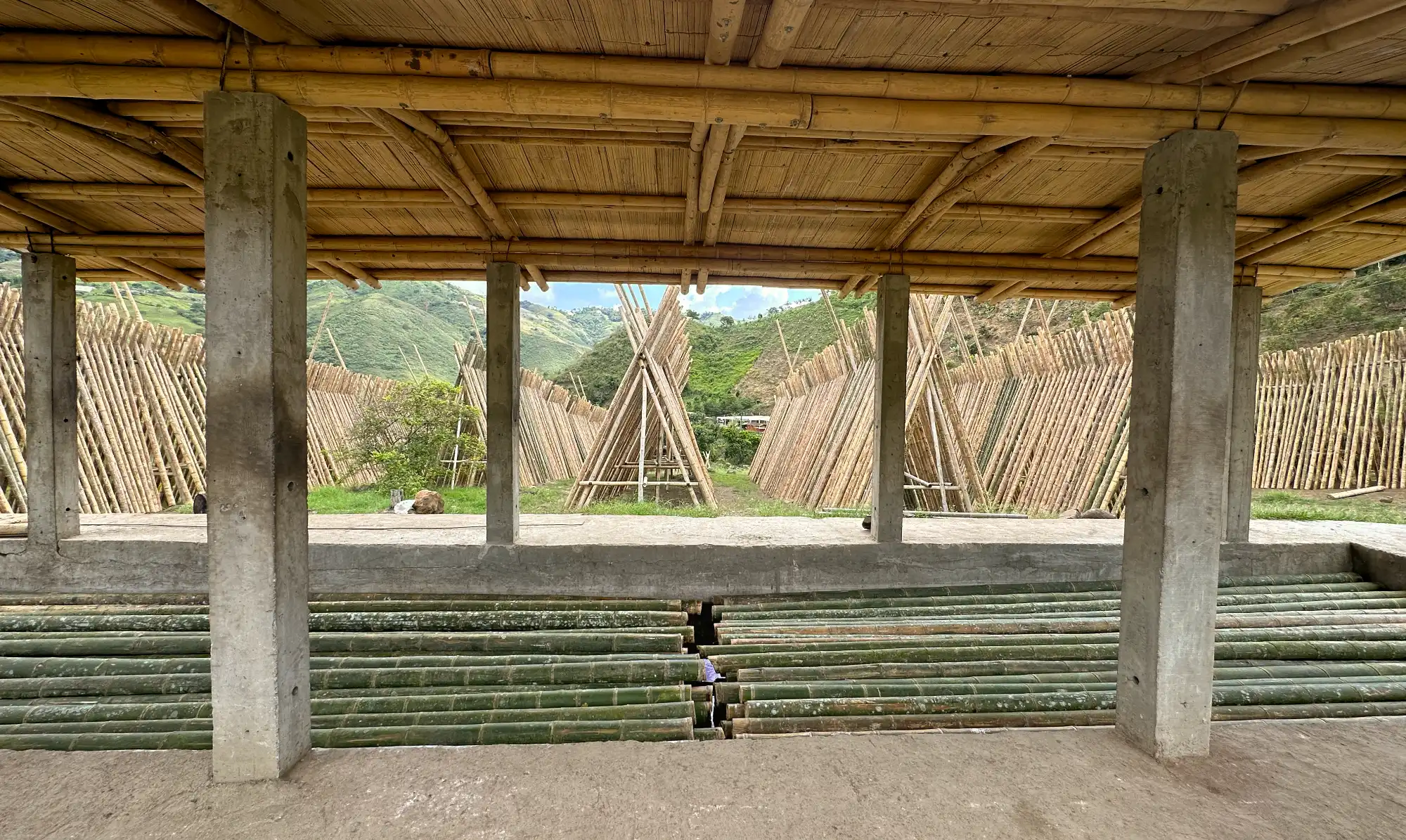
- Sun bleaching: After preservation, poles are set upright on drying racks to sun bleach for 2 to 4 weeks. Sun bleaching is always done vertically, never horizontally. Horizontal drying traps moisture on the underside of the pole, which causes warping and induces splitting. Vertical drying on well-supported racks gives moisture a clear path to escape without distorting the pole. Poles are rotated daily to ensure even exposure on all sides. This process accelerates initial moisture loss and breaks down chlorophyll in the outer layer, giving the poles their characteristic light, uniform beige color, which also makes surface treatments like stains easier to apply evenly.
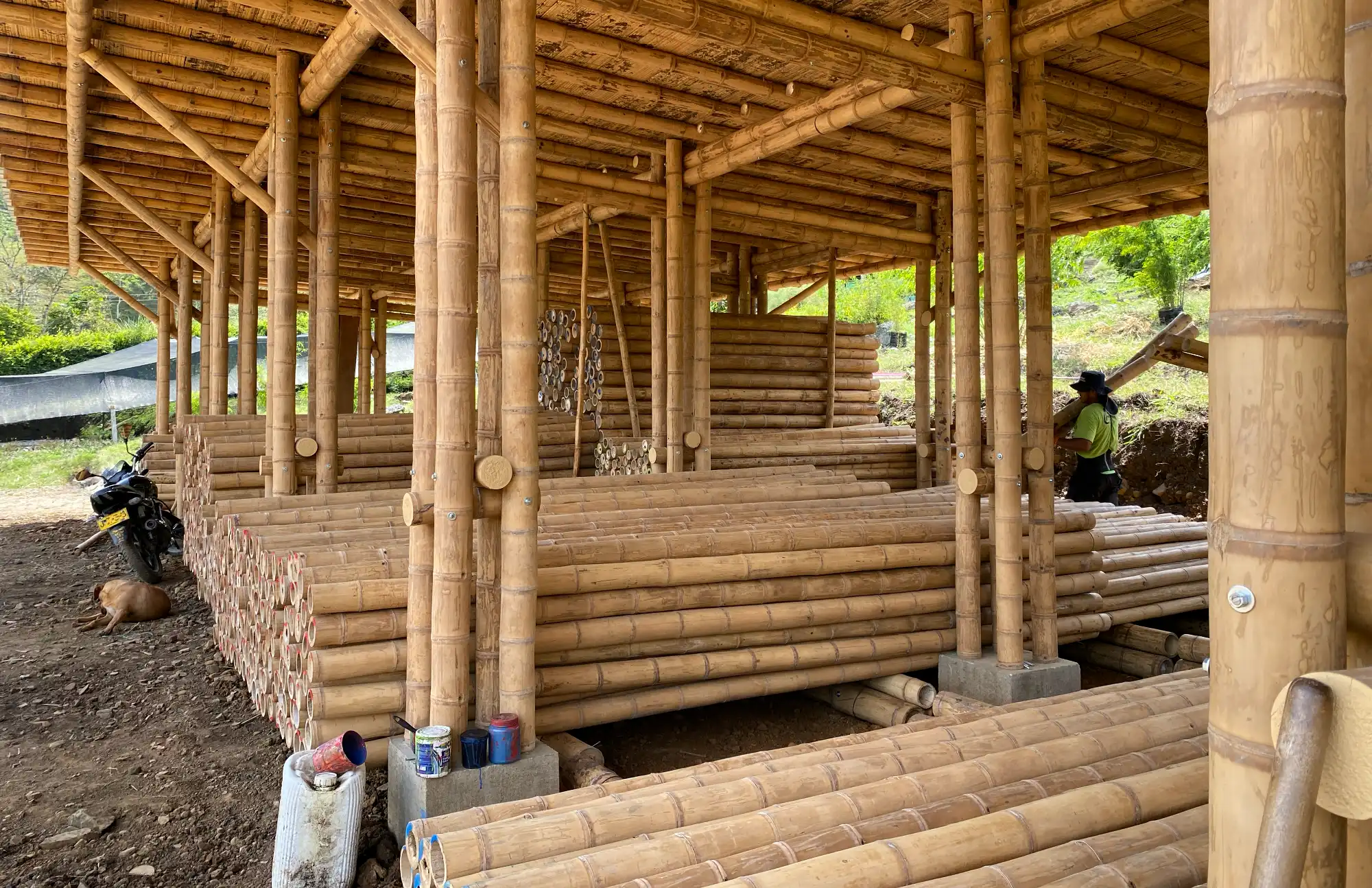
- Seasoning: Once sun bleached, poles are moved to our covered warehouse, cut to their final commercial lengths, and left to season under roof for a further 4 to 6 months. Good ventilation is essential throughout this stage. Poles are isolated from the ground and stacked with spacing that allows continuous air circulation, which prevents trapped moisture and mold while allowing the culm to dry evenly from the outside in. This slow, shaded drying phase is what brings the poles down to a stable, seasoned equilibrium moisture content.
- Grading: Only once a pole has reached seasoned moisture content is it assessed for fissures, curvature, diameter, and the other parameters of the Guadua Bamboo® Grading Standard.
* Kiln drying: We do not kiln dry round bamboo poles. Kiln drying forces moisture out too quickly, and because the less dense inner wall of a bamboo culm dries faster than the denser outer wall, this mismatch induces cracking. Our air drying process is slower by design, which is what allows the pole to dry evenly through its full wall thickness.
Moisture Content Classification
We track moisture content at each stage of production to confirm the poles are progressing correctly through the drying process.
| Stage | Moisture Content | Timing |
|---|---|---|
| Maturity Check | ≤ 55% | Standing, pre-harvest |
| Sun Bleached | 30% – 55% | 2 to 4 weeks |
| Air Dried | 20% – 30% | 2 to 3 months under roof |
| Seasoned | 14% – 16% | 4 to 6 months under roof |
A pole is classified as seasoned once its moisture content falls to 19% or below. All poles graded and shipped under the Guadua Bamboo® Grading Standard meet this threshold.
Moisture Content and Your Project
Our standard export stock is fully seasoned, at or below 19% moisture content, before it is graded for any other parameter. This is not an optional step. Poles that have not seasoned properly are held back and re-tested rather than shipped early.
For projects in humid climates or with specific moisture documentation requirements, we can provide moisture content records with your shipment on request.
If you have questions about drying, seasoning, or moisture documentation for your project, contact our technical team.