
Black Spots & Aesthetics
Guadua Bamboo® Grading Standards
Understanding Black Spots on Guadua Bamboo
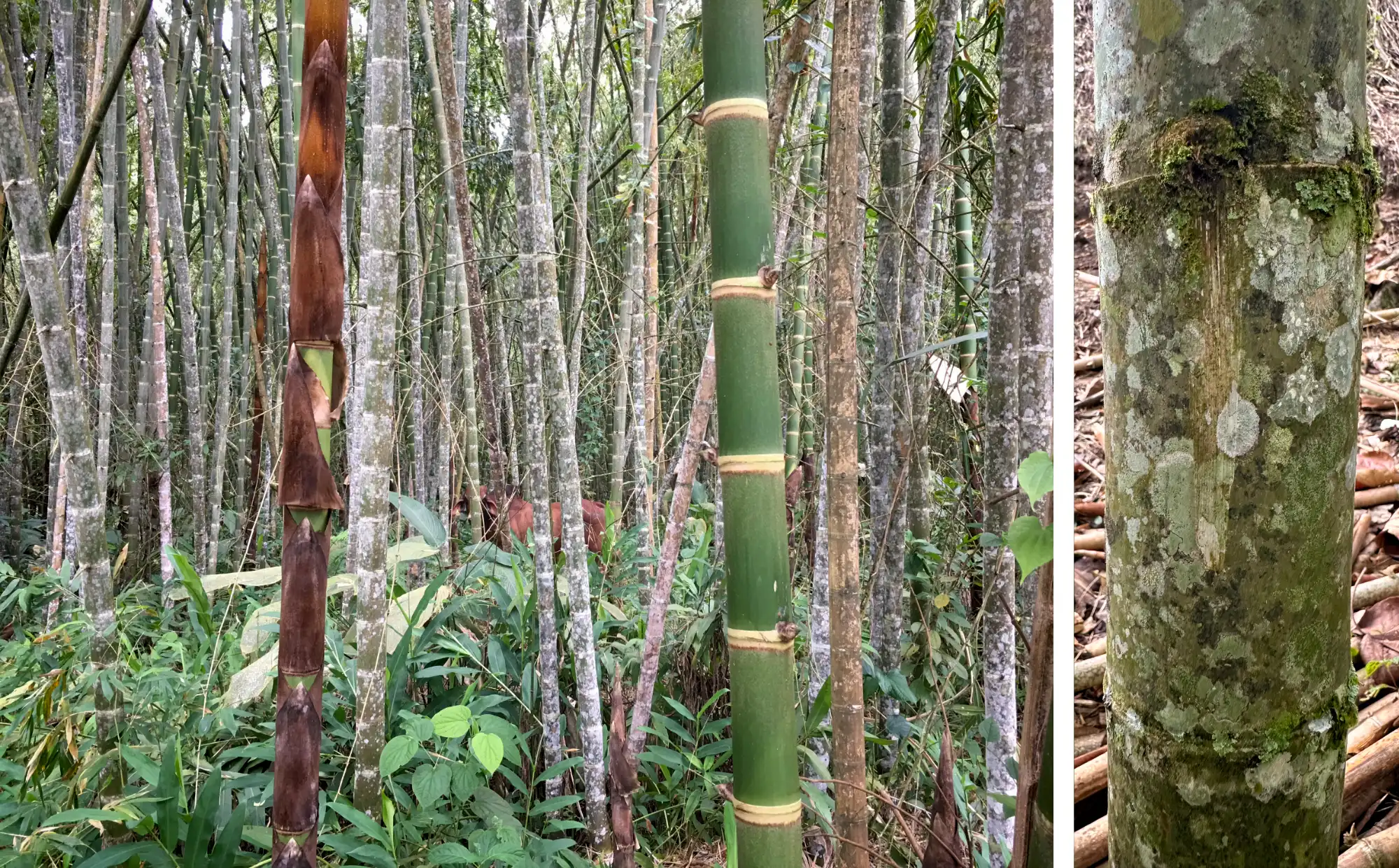
The vast majority of Guadua angustifolia culms develop black spots on their outer skin during maturation. These markings are caused by lichens that grow on the surface of the bamboo in the humid, tropical conditions of the plantation. The exact biological trigger for the coloration is not fully understood, but the source is well established: greyish white lichens interact with the outer skin of the culm and leave dark markings behind as a byproduct of their activity.
It is important for builders, architects, and engineers to know that these markings are purely cosmetic. Lichens are not parasitic. They draw their nutrients from air and rainfall, not from the bamboo itself, and they never penetrate past the outer cortex into the structural fibers of the wall. Black spots are not a structural defect or an affectation that detracts from the physical or mechanical quality of the guadua.
What Causes the Black Spots
In a managed plantation, the appearance of lichens is a useful natural indicator of a culm’s age. Lichens begin appearing once a culm reaches roughly 3 years of age. By years 4 to 6, they typically cover the culm, which is one of the visual signals we use alongside other maturity indicators to confirm a stand is ready for harvest.
Several regional and environmental factors appear to influence how much spotting develops:
- Altitude: Guadua grown at higher altitudes, around 1,600 meters above sea level, tends to develop more surface spotting. Colder mountain temperatures slow the bamboo’s growth rate, producing a denser, harder culm. Heavier spotting at altitude is generally associated with this increased density and structural hardness.
- Proximity to livestock: Field observations suggest that bamboo grown near cattle develops spots more readily, possibly linked to ammonia and shifts in surface pH. This remains an observed pattern rather than a proven mechanism.
- Humidity, light, and temperature: These general growing conditions also play a role, though the precise relationship has not been scientifically isolated.
Why Black Spot Grading Matters
Black spots have no effect on structural performance, but they do affect visual perception, and managing that perception is critical to setting the right design expectations. Perception is also culturally shaped. Natural variations are viewed differently across markets: in regions where Guadua grows, they are widely appreciated as part of the material’s authentic character, much like veining in natural marble or grain variation in solid wood, while in markets like the USA and Europe, accustomed to uniform industrial materials, expectations for a clean surface are higher.
Grading for black spots exists to bridge that gap. It separates poles into distinct aesthetic categories, from exceptionally clean material to heavily charactered poles suited for rustic outdoor framing, giving every client a clear, verifiable way to specify exactly the surface appearance they want rather than mistaking natural lichen spotting for rot, mold, or a defect.
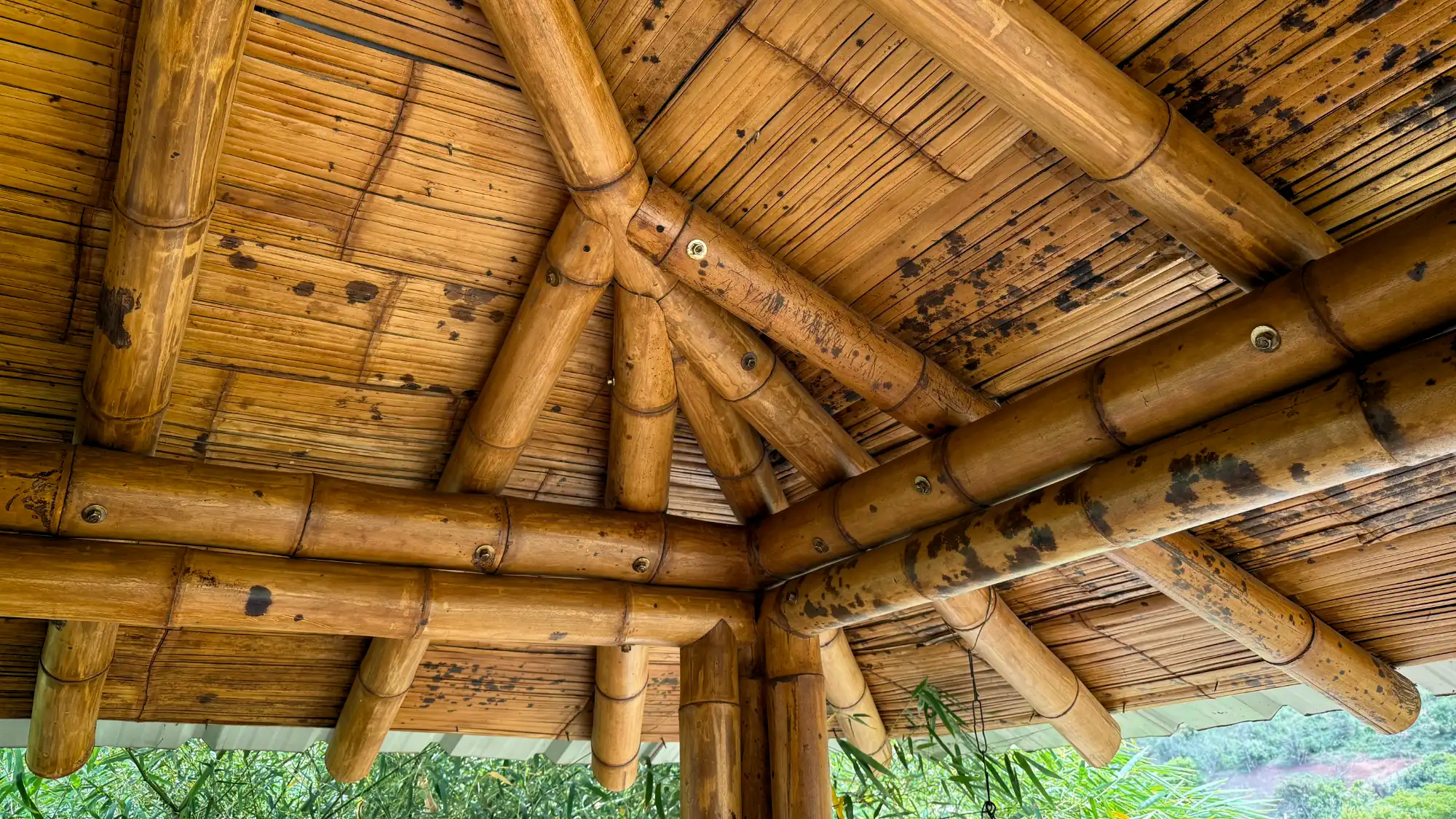
Because most mature Colombian Guadua naturally develops significant spotting, entirely clean poles are exceptionally rare and difficult to source. This intensive sorting is what drives a price premium on spot-free material. At the same time, heavily spotted poles have their own market: character-rich culms with bold, natural surface patterns are sold as “Tiger Guadua,” valued specifically for their distinctive look in exposed architectural applications.
If a fully uniform, glossy surface is a hard requirement, other bamboo species such as Moso are better suited to that aesthetic than Guadua, though Moso does not offer the same structural load-bearing performance for heavy-duty construction.
Black Spot Classification
We classify poles into 4 grades based on the percentage of internodes affected by spotting. A spot only counts toward this percentage if it measures 5 cm or more in diameter, or if several smaller spots in the same internode add up to 5 cm.
$$ \text{Range \%} = \frac{\text{Internodes with spots} \times 100}{\text{Total internodes}} $$
Based on this formula, we classify our inventory into the following standardized appearance grades. The specific threshold values are part of the proprietary Guadua Bamboo® Grading Rules, available to registered members.
| Black Spots | Grade | Range |
|---|---|---|
| Minimal | A+ | 🔒 |
| Normal | A | 🔒 |
| Medium | B | 🔒 |
| High | C | 🔒 |
* This technical data is reserved for our commercial partners. If you are already a partner, please log in here to view the full specifications. If you would like to access our professional resources, please request access here.
Inspection Process
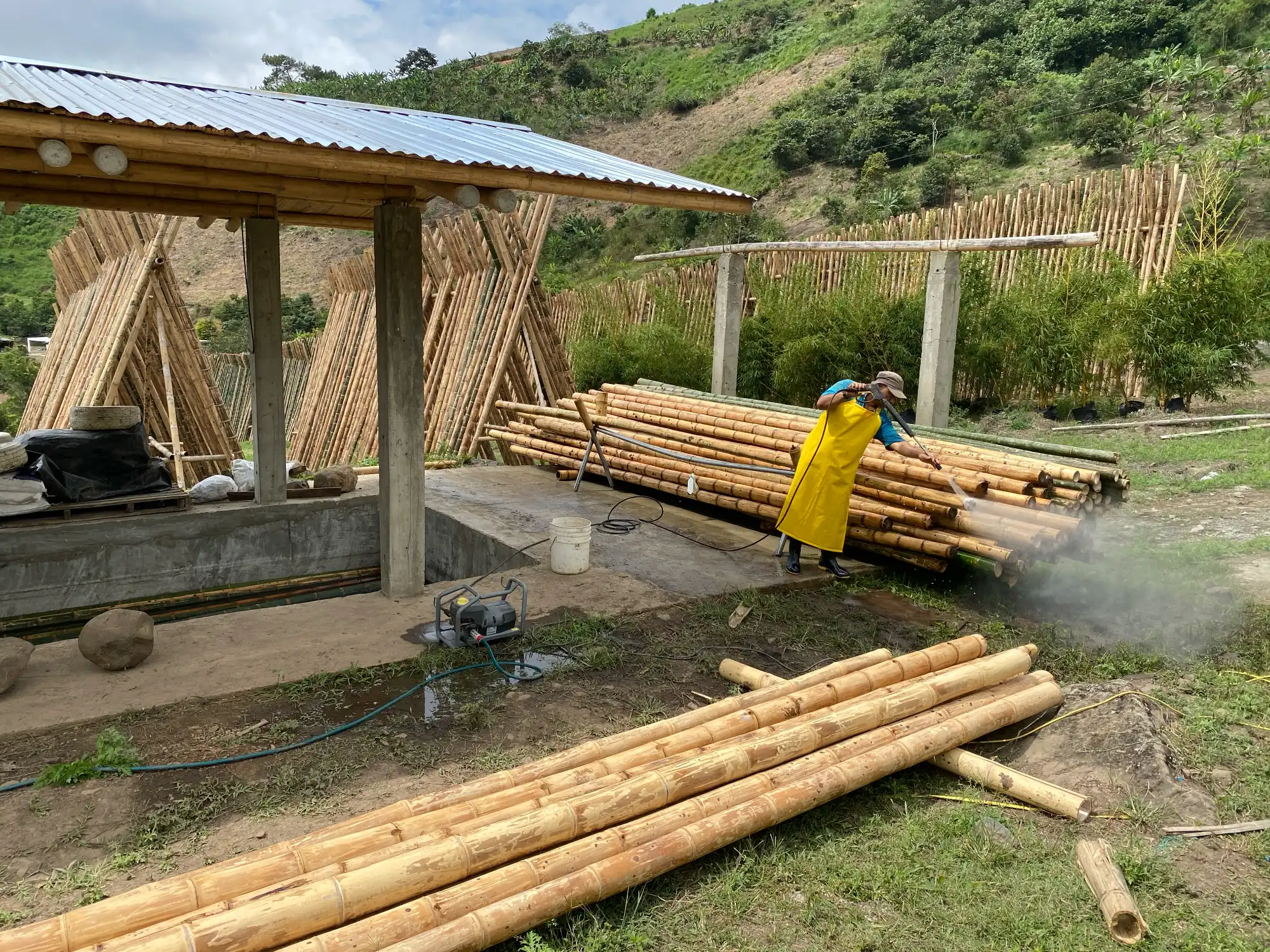
Every pole is assessed individually before it leaves our facility in Colombia.
- Surface cleaning check: Poles are pressure washed to remove moss, lichen residue, and surface dirt, revealing the underlying pigmentation. Final grading is performed once the pole is fully dry, since dried culms show spotting more clearly than freshly harvested green Guadua.
- Visual internode assessment: Each pole is rotated 360 degrees along its full length. Graders visually assess the proportion of internodes affected by qualifying spots (5 cm or more, individually or combined) and estimate the overall range based on this rotation.
- Percentage calculation: The number of affected internodes is divided by the total internode count and multiplied by 100 to determine the exact aesthetic range percentage.
- Grade assignment: Based on the resulting percentage, the pole is assigned its grade and sorted accordingly.
Choosing a Black Spot Grade for Your Project
Black spot grade is a design choice, not a structural requirement, giving you flexibility to match the surface appearance to the application.
- Clean, uniform preference: For clients or markets that expect a consistent, industrial-style finish, specify Grade A+ for minimal spotting. This grade carries a price premium due to the intensive sorting required.
- Natural, authentic preference: For clients who accept the traditional Guadua look, standard Grade A poles carry some light, natural spotting.
- Bold, expressive preference: For clients seeking a distinctive statement finish, Tiger Guadua (Grade B or C) offers pronounced natural patterning.
Pro Tip: Apply an open-pore wood stain (Lasur) for any structural application, especially exposed exterior elements where UV protection is critical. A slightly darker tone also helps natural spots blend more seamlessly into the overall finish.
Whatever grade you specify, black spots are never a sign of decay, rot, or structural weakness. They are a natural, cosmetic characteristic of mature Guadua bamboo.
If you have questions about black spot grading for your project, contact our technical team.
Bamboo Grading Criteria
Explore all the technical assessment factors used in our Guadua Bamboo® Grading Standard to ensure structural quality.