

Bamboo is one of the most resilient and versatile plants on Earth, but its natural distribution is often misunderstood. Many assume bamboo is strictly an Asian plant, but its reach is truly global.
In fact, bamboo grows native on 5 continents: Africa, Asia, South America, North America, and Australia. Coincidentally, all continents except Antarctica and Europe have diamonds.
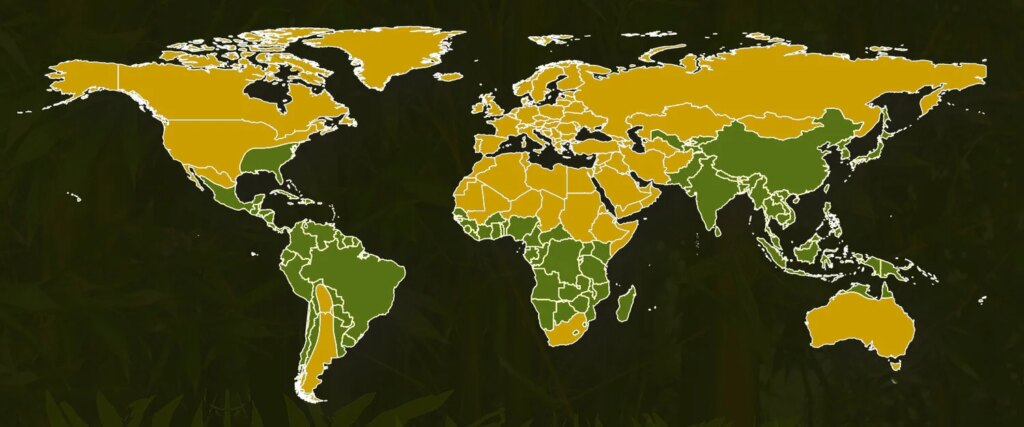
Asia: The Epicenter of Diversity
Asia is the undisputed heart of the bamboo world. It holds the highest number of species and the most established commercial industries.
- The Scale: India and China alone account for over 50% of the world’s bamboo resources.
- Climate Adaptability: While we often associate bamboo with tropical jungles, species like Phyllostachys edulis (Moso) thrive in cooler, temperate climates and can easily withstand snow and frost.
- The Giants: This continent is home to some of the world’s tallest timber bamboos, with some culms reaching over 30 meters in height.
The Americas: Home of the World’s Strongest
Contrary to popular belief, the “King of Bamboo” isn’t Asian. The strongest bamboo in the world, Guadua angustifolia, is native to the Americas.
- The Coffee Axis: Guadua is most famous in the coffee-growing regions of Colombia and Ecuador, where it has been a primary construction material for centuries.
- Extreme Elevations: In the Andes mountains, bamboo species have adapted to the thin air and freezing temperatures of the highlands, growing at altitudes up to 4,000 meters.
- North American Natives: Many are surprised to learn that the United States has three native species of bamboo, known collectively as “River Cane,” found primarily throughout the Southeast.
Africa: The Tropical and Montane Frontier
African bamboo plays a vital role in the continent’s most sensitive ecosystems, often growing where other timber cannot.
- Highland Bamboo: Oldeania alpina grows in the high-altitude volcanic soils of Eastern Africa (Ethiopia, Kenya, and Uganda). These forests are essential habitats for the endangered Mountain Gorilla.
- Economic Potential: In Western and Central Africa, bamboo is a critical resource for local communities, providing a sustainable alternative to traditional wood for fuel, tools and building.
Australia: The Northern Tropical Belt
While Australia has fewer species than Asia, its native bamboos are uniquely adapted to the harsh “Wet and Dry” cycles of the Southern Hemisphere.
- The Outback Survivors: Species like Bambusa arnhemica grow in the tropical north. They have evolved to handle intense seasonal flooding followed by months of extreme drought.
Why Europe and Antarctica are the Exceptions
Why did nature leave Europe and Antarctica out of the “Bamboo Club”?
- Europe’s Lost History: Fossil records show that bamboo actually lived in Europe millions of years ago. However, the extreme cold of the Ice Ages wiped them out. Unlike in the Americas or Asia, where plants could migrate south to warmer pockets, the Mediterranean Sea and the Alps acted as a barrier, preventing European bamboo from escaping the ice.
- Antarctica: The continent’s permanent ice cover and extreme temperatures make it the only place on Earth where no higher plant life, including bamboo, can survive natively.
A Plant of Extremes
While bamboo avoids the cold of the poles, it is far from fragile. Across these 5 continents, bamboo survives temperatures ranging from -25°C to over 40°C. It grows from sea-level coastal plains to the oxygen-thin peaks of the Himalayas.
Whether it is providing income for a local woman in a Colombian village or sequestering carbon in a Chinese forest, bamboo’s global footprint is a testament to its status as the most important plant of the modern era.
I am considering growing Bamboo in Ireland. Does anyone have any experience of growing Bamboo in a temperate climate that is approx 15 to 25 degrees celsius in summer and relatively mild winters of 5 to 12 degrees. There may be short colder spells where night temperatures up to 0/-2.
A farmer did a trial here in 2014 with the support of a university which I will to get some information on. My plot is small 2 acres and would only be a small scale trial. If it is possible my main questions are what variety is most suitable and would the invasiveness of Bamboo cause me major problems.
In Central European countries the most cultivated bamboos are found in the genera Phyllostachys and Fargesia. Both genera are temperate bamboos but Phyllostachys species are invasive runners whereas Fargesia species are non-invasive clumpers.
The species choice depends on the end use of the bamboo. For example, are you aiming to produce timber or ornamental plants? Moso Bamboo (Phyllostachys edulis) has successfully been introduced in several Eastern European countries, and has many uses. Fargesias are often sold as screening / hedge bamboo.
Phyllostachys can become invasive, so rhizome barriers may have to be put in place to prevent issues with the neighbors.
Very good info here and nice to see your plantation in progress. I read about the ideal growing conditions for guadua. Does that mean that for Portugal you would recommend other species, or do you think it can still be worth trying (on a smaller scale)? Do you know any examples of guadua growing in less tropical climates?
Hi everyone, I grow many bamboo types in continental Portugal (inland). Winters seem similar to what you describe, summers are 30’s – 40’s. Just one variety suffers in winter, all the rest are very hardy. Some watering required in summer.
I am looking to connect with other bamboo farmers in Europe for possible exchanges.
Hi just for general interest, I visited a bamboo park in Ireland. It was great to see different examples. As you advised phyllostachys and fargesia as being likely species, both were being grown.
Some of the types grown are P. bambusoides castillones inverse, P. aurea nolochrysa, P. nigra henonis, P. edulis, P. nigra boyana, Fargesia robusta.
The culms seemed to vary from between approx. 1 to 4 inch in diameter and the culms about 20 ft high.
What is the name of the bamboo park and where is it located? Thanks!
It is in Cork, Glengariff. It is more ornamental gardens as opposed to a bamboo “forest” but plenty of examples of successfully grown bamboo.
Before you start growing bamboo you need to know whether you have a market for the bamboo you will be able to grow on your plot. Unless of course your only aim is to have a nice green bamboo field.
Most Fargesia species and varieties will grow very well in Ireland but the question is whether you can monetize it.
Most Phyllostachys species will grow reasonably well in Ireland although will not be growing very tall and not produce thick culms. In particular Moso might not grow fast and tall and only produce small and thin culms after many years! Moso needs warm summers and approx. 1400 mm of which most of it during the growing season. Moso also grows best on hilly terrain as it does not like standing water. It grows well in the mediterranean are where there is sufficent rain and in European countries with a continental climate and mild winters).
Depending on the purpose, you might also consider some Pseudosasa species (for example Pseudosasa amabilis) or Semiarundinaria species.
Hi thank you for the very helpful feedback. My first aim is to create a mini Bamboo forest. The commercial focus is not that important to me on initial planting as I’m sure I’ll make countless mistakes but ideally I would like Bamboo that if harvested could be processed into timber/used to create similar products that hardwoods are currently used for as opposed to ornamental garden plants for a nursery. Would this make sense to make the main planting a species that is most likely to survive and try 2/3 other species also on a smaller scale?
is it possible to grow them in Uzbekistan