

63 Species
Gigantochloa is a tropical genus of giant clumping bamboo, similar to the genus Bambusa.
Bamboo species of this genus grow native to: Andaman Is., Assam, Bangladesh, Borneo, Cambodia, China, East Himalaya, India, Java, Laos, Lesser Sunda Is., Malaya, Maluku, Myanmar, New Guinea, Philippines, Sulawesi, Sumatera, Thailand and Vietnam.
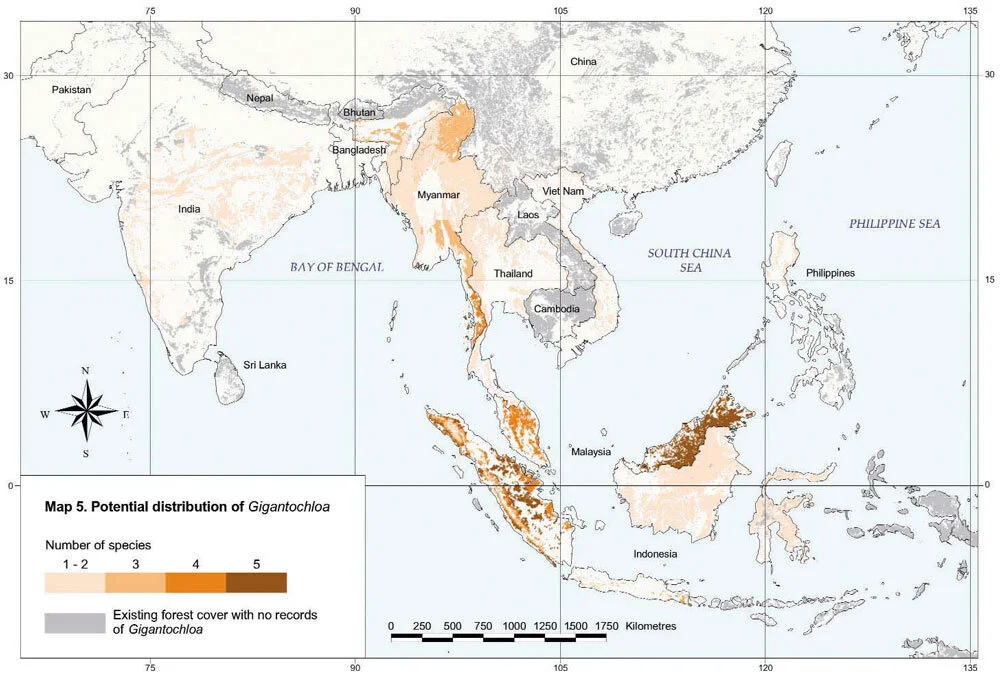
Gigantochloa Species List
| Species | Origin | Diameter | Height |
|---|---|---|---|
| Gigantochloa achmadii | Sumatra | ∅ 90 mm | ⇑ 20 m |
| Gigantochloa albociliata | Assam, Bangladesh, China South-Central, East Himalaya, Laos, Myanmar, Thailand, Vietnam | ∅ 25 mm | ⇑ 10 m |
| Gigantochloa albopilosa | Malaya | ∅ 50 mm | ⇑ 12 m |
| Gigantochloa albovestita | Malaya | ∅ 20 mm | ⇑ 12 m |
| Gigantochloa apus | Assam, Bangladesh, Borneo, China Southeast, Java, Laos, Lesser Sunda Is., Malaya, Myanmar, Thailand | ∅ 130 mm | ⇑ 22 m |
| Gigantochloa arcuta | China South-Central, China Southeast | ||
| Gigantochloa atroviolacea | China South-Central, China Southeast, Java, Lesser Sunda Is. | ∅ 80 mm | ⇑ 12 m |
| Gigantochloa atter | Borneo, Java, Laos, Lesser Sunda Is., Maluku, New Guinea, Philippines, Sulawesi, Sumatra, Vietnam | ∅ 100 mm | ⇑ 22 m |
| Gigantochloa austroyunnanensis | China South-Central | ||
| Gigantochloa aya | Lesser Sunda Is. | ∅ 100 mm | ⇑ 15 m |
| Gigantochloa baliana | Lesser Sunda Is. | ∅ 26 mm | ⇑ 10 m |
| Gigantochloa balui | Borneo | ∅ 80 mm | ⇑ 12 m |
| Gigantochloa bastareana | India | ∅ 50 mm | ⇑ 10 m |
| Gigantochloa brachystachya | China South-Central | ||
| Gigantochloa calcicola | Sumatra | ∅ 20 mm | ⇑ 10 m |
| Gigantochloa callosa | China South-Central, China Southeast | ||
| Gigantochloa cochinchinensis | Vietnam | ∅ 40 mm | ⇑ 6 m |
| Gigantochloa compressa | Myanmar | ∅ 100 mm | ⇑ 18 m |
| Gigantochloa densa | Cambodia, Laos, Vietnam | ⇑ 6 m | |
| Gigantochloa dinhensis | Vietnam | ||
| Gigantochloa felix | China South-Central | ⇑ 9 m | |
| Gigantochloa glabrata | China South-Central | ||
| Gigantochloa hasskarliana | Borneo, Jawa, Laos, Lesser Sunda Is., Malaya, Myanmar, Sumatera, Thailand | ∅ 60 mm | ⇑ 12 m |
| Gigantochloa hayatae | Vietnam | ||
| Gigantochloa hirtinoda | Sumatra | ∅ 80 mm | ⇑ 20 m |
| Gigantochloa holttumiana | Malaya | ∅ 55 mm | ⇑ 15 m |
| Gigantochloa hosseusii | Laos, Myanmar, Thailand, Vietnam | ||
| Gigantochloa kuring | Sumatra | ∅ 70 mm | ⇑ 25 m |
| Gigantochloa latifolia | Laos, Malaya | ∅ 80 mm | ⇑ 15 m |
| Gigantochloa levis | Borneo, China South-Central, China Southeast, Malaya, Maluku, Philippines, Sulawesi, Sumatra, Vietnam | ∅ 100 mm | ⇑ 20 m |
| Gigantochloa ligulata | Malaya, Thailand | ∅ 40 mm | ⇑ 9 m |
| Gigantochloa longiprophylla | Sumatra | ∅ 80 mm | ⇑ 20 m |
| Gigantochloa luteostriata | Borneo, Lesser Sunda Is. | ∅ 50 mm | ⇑ 10 m |
| Gigantochloa macrostachya | Assam, Bangladesh, East Himalaya, Myanmar | ∅ 100 mm | ⇑ 16 m |
| Gigantochloa magentea | Sumatra | ∅ 60 mm | ⇑ 10 m |
| Gigantochloa manggong | Java, Lesser Sunda Is., Myanmar | ∅ 70 mm | ⇑ 15 m |
| Gigantochloa membranoidea | Sumatra | ∅ 50 mm | ⇑ 10 m |
| Gigantochloa multiculmis | Laos, Vietnam | ∅ 30 mm | ⇑ 10 m |
| Gigantochloa multifloscula | Vietnam | ∅ 50 mm | ⇑ 8 m |
| Gigantochloa multiradicans | China South-Central | ||
| Gigantochloa nigrociliata | Andaman Is., Assam, Bangladesh, Java, Laos, Lesser Sunda Is., Myanmar, Sumatra, Thailand, Vietnam | ∅ 60 mm | ⇑ 20 m |
| Gigantochloa pachyparietalis | China South-Central | ||
| Gigantochloa papyracea | Sumatra | ∅ 80 mm | ⇑ 15 m |
| Gigantochloa parviflora | China South-Central | ||
| Gigantochloa parvifolia | Cambodia, Laos, Myanmar, Thailand, Vietnam | ∅ 17 mm | |
| Gigantochloa poilanei | Laos, Vietnam | ⇑ 8 m | |
| Gigantochloa pruriens | Sumatra | ∅ 120 mm | ⇑ 15 m |
| Gigantochloa pubinervis | Lesser Sunda Is., Sumatra | ∅ 80 mm | |
| Gigantochloa pubipetiolata | Lesser Sunda Is., Sumatra | ∅ 80 mm | ⇑ 15 m |
| Gigantochloa ridleyi | Malaya | ∅ 100 mm | ⇑ 16 m |
| Gigantochloa robusta | Java, Lesser Sunda Is., Sumatra | ∅ 90 mm | ⇑ 20 m |
| Gigantochloa rostrata | Malaya | ∅ 35 mm | ⇑ 8 m |
| Gigantochloa scortechinii | Malaya, Sumatra | ∅ 120 mm | ⇑ 20 m |
| Gigantochloa serik | Lesser Sunda Is., Sumatra | ∅ 60 mm | ⇑ 15 m |
| Gigantochloa striata | China South-Central | ||
| Gigantochloa tenuispiculata | Vietnam | ||
| Gigantochloa thoi | Lesser Sunda Is., Malaya, Sumatra | ∅ 120 mm | ⇑ 16 m |
| Gigantochloa tomentosa | Sumatra | ∅ 80 mm | ⇑ 15 m |
| Gigantochloa velutina | Lesser Sunda Is., Sumatra | ∅ 80 mm | ⇑ 20 m |
| Gigantochloa verticillata | Borneo, Java, Malaya, Myanmar, Sumatra, Thailand, Vietnam | ∅ 100 mm | ⇑ 20 m |
| Gigantochloa vietnamica | Vietnam | ∅ 120 mm | ⇑ 20 m |
| Gigantochloa vinhphuica | Vietnam | ∅ 130 mm | ⇑ 25 m |
| Gigantochloa wrayi | Malaya, Myanmar, Thailand | ∅ 70 mm | ⇑10 m |
Source: Kew Science
Common Names for Gigantochloa Species
Bamboo growers and garden books frequently refer to bamboos by their ‘common name’. Below you’ll find a table with the most common English names for Gigantochloa species and their correct scientific names.
More common names in English can be found here: Common Bamboo Names.
| Common Name | Botanical Name |
|---|---|
| Java Black Bamboo | Gigantochloa atroviolacea |
| Tropical Black Bamboo | Gigantochloa atroviolacea |
Is there a difference in the level of sturdiness or hardness between Gigantochloa atter and Gigantochloa apus?
I am currently doing a project and need to decide on the specific bamboo species to be used. The project is investigating on which type of bamboo is a strong and sturdy bamboo that can withstand impacts during vehicle crashes.
I searched on the web and found that Gigantochloa atter and Gigantochloa apus are two commonly used bamboo species for construction purposes as they are strong. Is it possible to determine which of them is stronger than the other?
I did some quick research online and found the following data regarding the physical and mechanical properties of Gigantochloa apus and Gigantochloa atter:
The strength properties of Gigantochloa atter were tested in green (Moisture content 72.3%) and in air dry (M.C 14.4%) condition.- Average MOR varied from 8.79 to 10.81 N/mm2 from base to top in green and 11.77 to 12.77 N/mm2 in air dry.- Compression strength parallel to grain 24.77 to 27.97 N/mm2 in green, 32.87 to 30.98 N/mm2 in air dry.- Average tensile strength was 29.98 to 27.30 N/mm2 from base to top in green and 33.15 to 24.70 N/mm2 in air dry.- Average shear strength was 5.8 to 10.8 N/mm2 in green and 9.5 to 10.8 N/mm2 in air dry.
The strength properties of Gigantochloa apus were tested in green (Moisture content 54.3%) and in air dry (M.C 15.1%) condition.- Average MOR 10.20 in green and 8.75 N/mm2 in air dry, maximum crushing stress varies from 21.73 to 26.50 in green and 27.29 to 48.64 kN/mm2 in air dry.- Average tensile strength was 29.41 in green and 29.89 kN/mm2 in air dry.- Average shear strength in green varied from 5.99 to 7.68 whereas in air dry it was 7.47 to 7.65 kN/mm2.
Currently, at R&D stage of proposed relief structures constructed using bamboo. Location of the site is Leyte where I understand the local bamboo species is Gigantochloa atter (Kayali). As such was wondering, as the above information was ascertained through ‘quick research online’, what the best research material can be found; particularly with regard to mechanical strength properties. I look forward to hearing from you.