

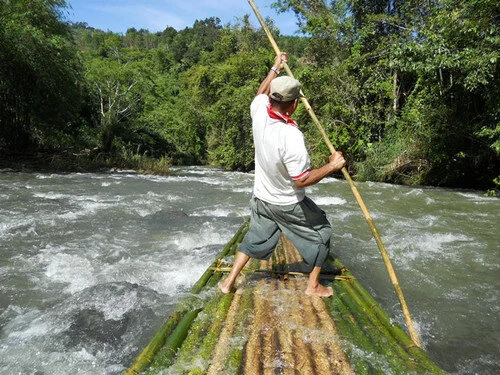
Storing bamboo in water or “leaching bamboo” is a traditional bamboo preservation method, used by indigenous communities and farmers of several Asian and Latin American regions. In Latin America it has been the tradition to transport bamboo from the mountain and jungle areas towards the urban centers by means of bamboo rafts.
When transporting bamboos over rivers, which generally takes 3 to 4 weeks, the starch content of the poles is subjected to a leaching process that tends to decrease the starch level and increases its durability. Therefore, when arriving at their destination, the bamboo culms are less susceptible to attacks of microorganisms and insects.
This method ofimmersing bamboo in water is still used today, especially when bamboo needs to be transported from remote areas. It is also recommended for storing bamboo, used in craft and mat applications where pliability is required. However, leaching alone, doesn’t guarantee long term protection but it does helps to remove starch and enhances permeability for future treatment by diffusion and pressure treatments.
How to Store Bamboo in Water?
You can store bamboo in tanks with water, but it is highly recommended to add chemicals in the tank to cure and preserve bamboo for long term usage.
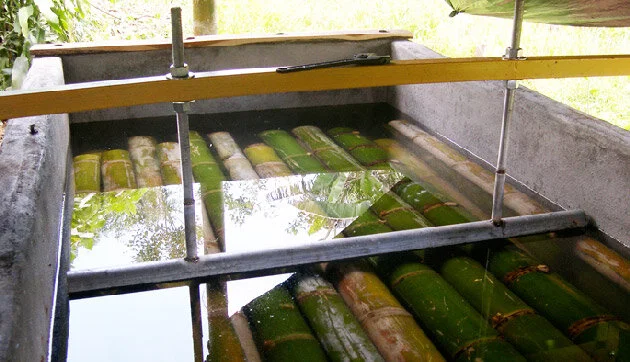
Nevertheless, whether chemicals are used or not, the steps outlined below need to be applied in either situation.
- When immersing round bamboo, nodes should be punctured before leaching. That way, water can run easily true out the bamboo cane.
- Bundle the bamboo culms or splits and store them in running water or tanks.
- When stored in tanks with stagnant water, change the water weekly to prevent growth of bacteria which will cause staining and bad odor.
- Use sinker loads for complete immersion.
- Bamboo can be submerged for variable periods of time, after which they are extracted for their use or further chemical treatment. Without further treatment they should be immersed for at least 3-4 weeks.
- An excessive time in water (after 3 months) causes stains in the epidermis of the bamboo and has the consequence to decrease its physical and mechanical properties.
I’ve read that submerging bamboo in sea water is another traditional treatment of bamboo. How long-lasting will the bamboo be using this treatment?
Let the poles or the splits dry thoroughly under the sun. Then soak them in the sea for 2 months. The dry poles and splits easily absorb all the salt of the sea. This sea-water treatment gives the bamboos at least 50 years of protection from termites, borers and fungi. It’s widely used in Asia and also used for wood treatment. Very safe and natural, very effective and cheap and truly long-lasting. Good luck.
Where is the evidence it lasts for 50 years? I think you would need to puncture the culms and practically it is difficult to keep the poles underwater with all the tidal activity. The best it could do is reduce borer/ beetle infestation but I think termites could still be a problem although the starch content will have been reduced considerably.
Is there a method to remove the starch content without puncturing the nodes which I guess would reduce the strength? Is it possible to pressure treat bamboo with water alone so that sap (starch) is removed, and horizontal soak diffusion in a tank with boric acid and Borax? This way effective use of the chemical is possible without the sap contaminating the chemical bath.
Do we have the same result if we just add salt on the water? I am not close to the sea at all.
I thought it might be worth suggesting you add a bit to this article:
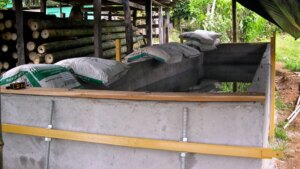
The effectiveness of leaching is very dependant on the wall thickness, starch content and age of the bamboo. If leaching is undertaken within hours of harvesting the vascular system will still be open, making it much easier for water to pass through it. Pre-drilling internodal spaces, often works better than punching nodes with smaller species.As with any diffusion based method of treatment, leaching will be quicker in warmer water and where there is greater water flow/movement. When leaching in a still water bath as shown in the image above the most you could ever achieve is equilibrium between the solution in the bath and that inside the culm wall, hence 100% removal of starches is not possible in a still bath. Some communities I have spoken to say a still bath is better as the sugars are converted by microbial activity and no longer attractive to pests. This may well be true for some species though many articles argue this partially decomposes the culm reducing it’s the strength.
In answer to a question above about leaching in salt water. Leaching in anything that tastes bad to bugs will have a slightly positive effect. Salt does however increase the wicking potential of the bamboo so you need to be even more careful of keeping it free from ground contact and rain.
Can we soak bamboo in pressure treatment plant and fill it with the water and give pressure???? Do you think that this will help us to reduce the soaking time and also give better results to reduce starch content?