

For centuries bamboo has been used in everyday life and in many different cultures throughout the world. A gigantic and extraordinary type, known as Guadua angustifolia ‘Kunth’, is considered one of the best bamboo species for commercial farming.
In 1822, the German botanist Kunth described Guadua as a genus segregated from the Asian one, Bambusa. Kunth used the indigenous word “guadua” (narrow leaf), which was the name given to this bamboo among the native communities of Colombia and Ecuador.
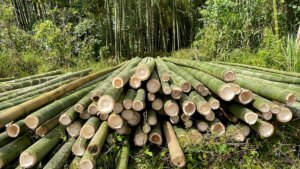
This user-and environmental-friendly grass (often referred to as “Vegetal Steel”) is presently employed for a multitude of uses; furniture & crafts work, raw construction material, panels (plywood, laminates, floors), bio-energy industry, musical instruments, houses, etc.
Guadua bamboo is by far the most important bamboo in America, and is often compared with its Asian counterpart: Moso (Phyllostachys edulis). For a detailed comparison see: Guadua vs Moso
The reason for that is simple: no other natural resource possesses more: versatility, lightness, flexibility, endurance, hardness, strength, climatic adaptability, seismic-resistance, rapid growth, easy handling and visual warmth!
To top this of, Guadua can easily meet the International Building Code (IBC) and all environmental requirements. So it’s no exaggeration if we state that the Guadua bamboo is the American forestry species of the future!
Trees vs. Guadua angustifolia
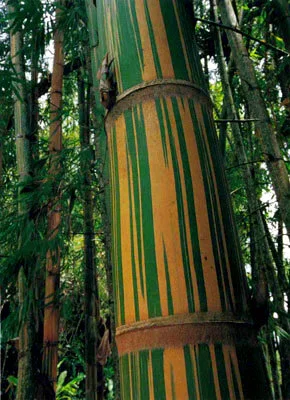
All bamboo, but Guadua in particular, has a rapid growth and a higher productivity, when compared with trees. Usually, the growth cycle of bamboo is a third of that of a “tree of rapid growth” and has double the productivity per hectare. Compared to oak, Guadua even produces up to four times more wood.
In addition, bamboo emerge from the soil with a fixed diameter, without showing increases of diameter over time, as happens with trees. The maximum diameter reported for Guadua angustifolia is 25 cm and the average is between 9 and 13 centimeters.
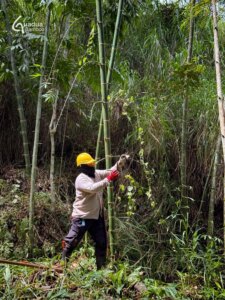
In the case of Guadua, a 21 cm daily growth in height has been observed, so that it reaches its maximum height (15 – 30 meters) in the first six months of growth and can be harvested after 4 to 5 years. This growth is rarely surpassed by the native timber species of the region.
If handled properly, guadua may have an unlimited production once it has been established, without a great deal of care. The ideal composition of culms in a guadua grove is estimated to be 10% shoots, 30% young ones, and 60% mature ones with a density of 3000 to 8000 culms per hectare. This means a productivity of 1,200 – 1,350 culms per hectare per year, and an effective alternative to wood for production of laminated and agglomerate wood (columns, beams, girders, planks, panels, etc.)
Where does Guadua angustifolia grow?
There currently exists 38 known species of Guadua bamboo which are all found in Central and South America. The species Guadua angustifolia however, is only native to Colombia, Ecuador, Peru and Venezuela, where it forms dominant colonies known as “guaduales” or guadua groves.
These Guadua forests reach their optimum development in the central region of the Andes, between 900 and 1,600 meters above sea level, at temperatures between 20° and 26° Centigrade, rainfalls of 2,000 – 2,500 mm/year, a relative humidity of 75 – 85% and on alluvial soils that are rich in volcanic ash with a moderate fertility and good drainage. Guadua angustifolia has been introduced to several Central American, Caribbean and Asian countries where they can grow in similar climate conditions.
Environmental advantages of Guadua
Guadua bamboo has a large environmental impact. It conserves the soil, controls erosion, regulates the flow of rivers and streams, supplies organic material, and acts as a CO2 sink.
Its rapid growth, both aerial and sub-surface, the network of rhizomes that grow in the superficial layer of the soil (20 – 50 centimeters) and its willingness to occupy disturbed areas make guadua an ideal resource for the conservation of unstable soils.
Bamboo also captures CO2 and converts it into oxygen, 35% more than regular trees; therefore it plays a vital role in a healthy eco-system. Recent studies indicate that the potential for atmospheric carbon dioxide fixation in the first six years of Guadua’s growth from new sowings is 54 metric tons per hectare – a fundamental discovery that facilitates participation in the international system of trading emission rights and will bring additional benefits to investors and farmers who plant and cultivate guadua, that produces zero emissions!
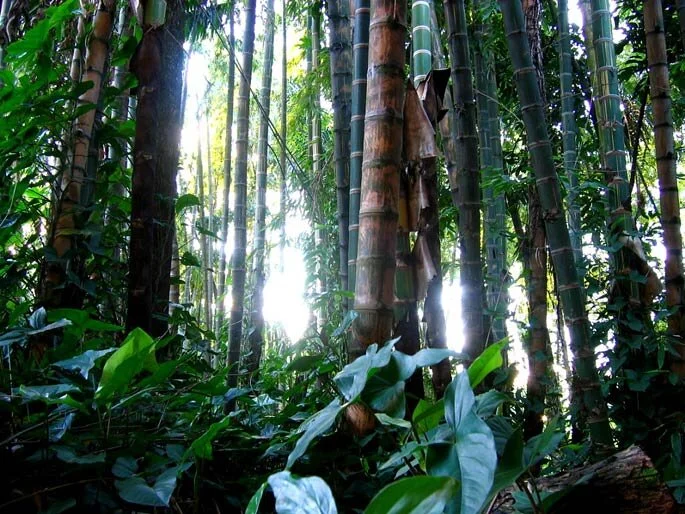
It is also important to point out that using guadua in industrial processes would significantly reduce negative environmental impacts on native forests, since guadua becomes a substitute for timber, thus reducing the pressure on the tropical jungle.
Whenever we use bamboo we make a valuable contribution to the environment, with its high per hectare density, rapid growth, ready exploitation and enormous capacity for renewal without reforesting we leave the much slower growing hardwood forests untouched.
I read about two different rhizome positions of Guadua angustifolia (nearly vertically positioned rhizome with collective feet and horizontally positioned rhizome).
Here in Ethiopia, North East Africa, there is mountain bamboo that has a similar rhizome position (nearly vertically positioned) with collective rhizome feet. I want to compare Guadua angustifolia and Ethiopian mountain bamboo in their rhizome morphology, but I become confused with the two different rhizome positions of Guadua angustifolia mentioned.
I need clarification about rhizome forms of the species.
There is quite some confusion about the rhizome structure of Guadua angustifolia as Guadua species are classified as clumpers, however the reality is quite different…
The long-necked rhizomes can easily extend between 1 and 2,5 meters before turning upwards into a new culm, and outdistancing some bamboos with leptomorph (running) rhizome systems. Rather than “clumping” bamboo, Guadua bamboos are more properly characterized as having a pachymorph rhizome system with a diffuse habit (or “open clumpers”) – though even this often understates the matter.
The real question I’d like to see an answer to is… can they be contained once planted, or is it inevitable they will take over the property over time?
They won’t take over your property like running bamboos since Guadua still grows in clumps. However these clumps will continue to expand and can become 10 meters in diameter in about 10 years (under optimal conditions). So I won’t advise planting them in a backyard of a few square meters.
Simple rhizome barriers won’t hold up against these massive Guadua’s but you could somewhat keep them under control by eliminating the young shoots (just chop them down).
Is Guadua being grown anywhere in the U.S. yet? And which USDA Zones would be capable of growing Guadua?
This is great for the environment. I wish to learn more and get this to Tanzania
Is it easy to control the spread? if I only want them on certain areas and not occupy the whole land.
Fantastic! I would like to get Yong plants of that Guada. Can you export it to Africa?
Great Bamboo! It’s one of the Best. I wish to get these in India.