

Basic Principles and Techniques
How to join bamboo and what are the best bamboo joints? Well first of, it is important to know a few basics principles about joining bamboo before discussing the different joinery techniques. So here goes…
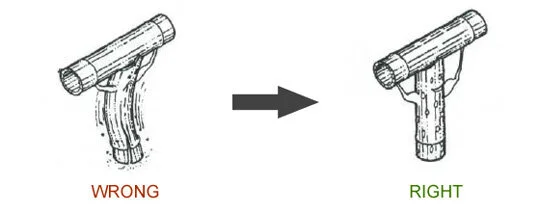
- Do not use green, fresh cut bamboo. Bamboo has to be completely dry before using it in construction (preferable air dried). During the drying process the bamboo diameter shrinks, so when bamboo is used in joinery this will result in lose and weak joints after a few weeks.
- Do not use bamboo when it is less than 3 years of age. Only use mature bamboo of 4-6 years.
- Do not use bamboo infected by insects (powder beetle for example). Bamboo has to be properly cured with a boron mix immediately after harvesting.
- Do not use bamboo that has flourished. Rest assured bamboo only flourishes once in a lifetime (60-120 years).
- Do not use bamboo poles with profound vertical cracks.
- Use appropriate cuts and joints when building with bamboo.
- Use bamboo with the right diameter and wall thickness for your project.
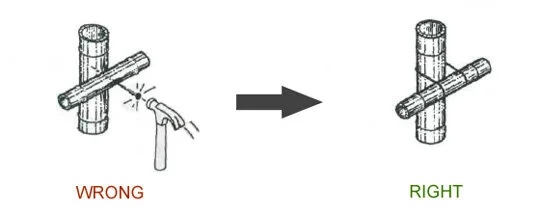
- Do not use conventional wood nails in bamboo joinery, they will cause the bamboo to split. Instead use nylon, steel or vegetal cord of the appropriate diameter.
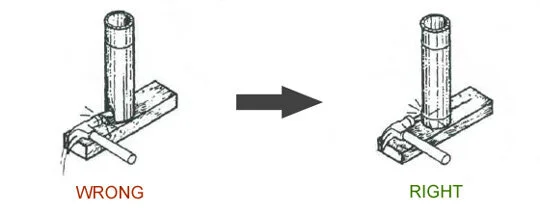
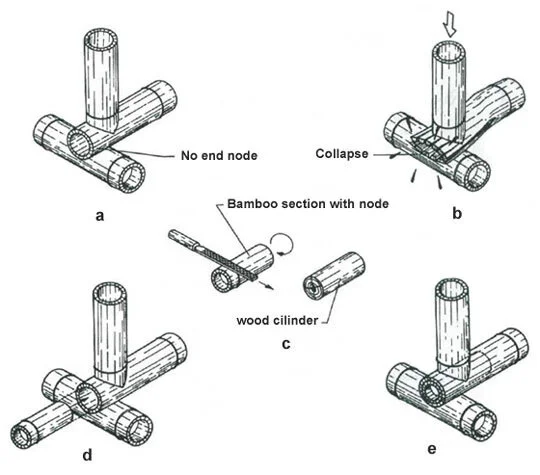
- When using bamboo as a column make sure that the lower part connecting with the surface ends with a node. If not the bamboo will splinter when struck (for example to position the column).
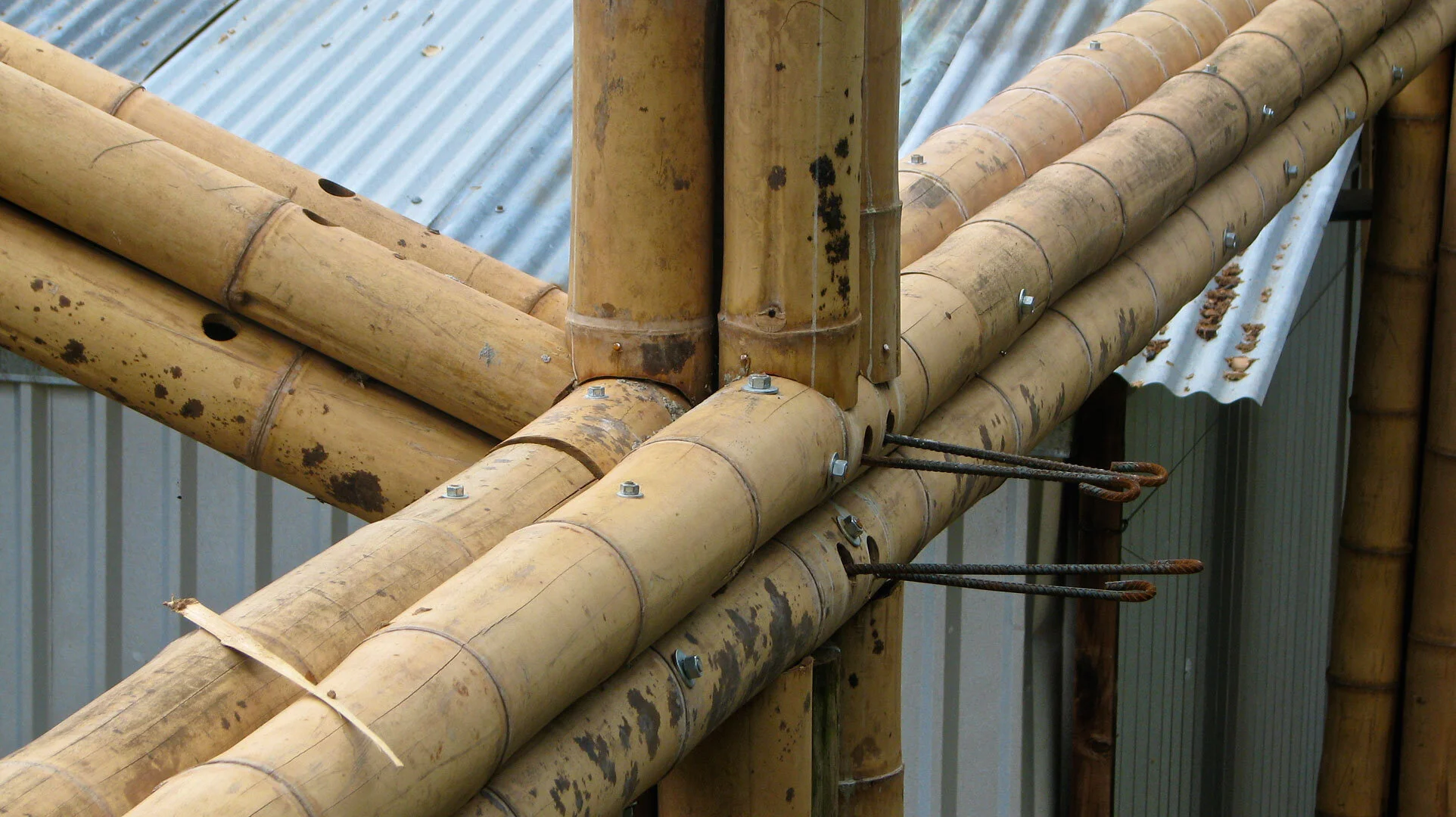
- When connecting bamboo poles with bolts, make sure to bolt them together in between 2 nodes, otherwise the bamboo may crush. More about utilizing the nodes below…
Bamboo Has Nodes, Use Them!
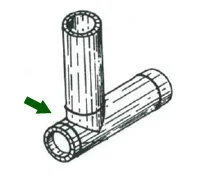
In construction, using bamboo nodes is very important. Bamboo columns or beams need to have a node at both ends (or as close as possible towards the ends), if not the pressure of a structure on the joint may crush the bamboo.
Often it isn’t possible to find bamboo of the required length with both end nodes in place. When this occurs you should insert a wooden cylinder of the appropriate diameter or a fitting piece of bamboo with a node.
Bamboo Cuts
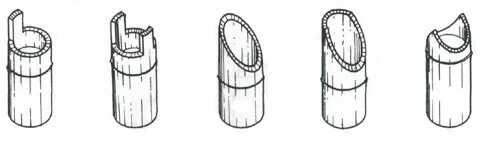
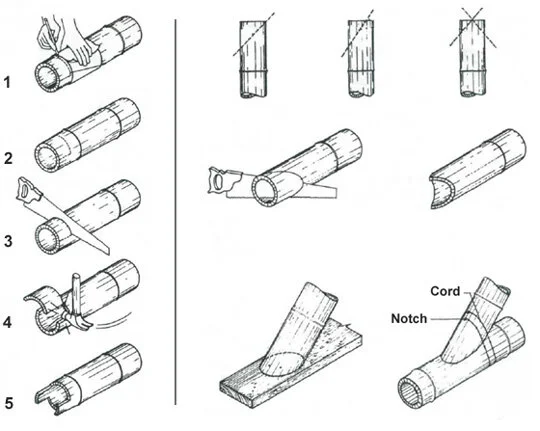
As you can see in the illustration below, making basic cuts in bamboo doesn’t require expensive or heavy power tools, just a few traditional hand tools will work fine.
Bamboo Joinery Techniques
Making good and aesthetically pleasing bamboo joints is rather complicated because bamboo is hollow, tapered, has nodes at varying distances, and it is not perfectly circular. It is important to keep all these constraints in mind when designing a bamboo joint.
Although traditions, local practices and publications give some information on bamboo joinery, this information is far from complete as essential data is missing in most cases. Many traditional joinery techniques suffer from weakness or deformation, where the strength of the bamboo culm itself is lost.
Before bamboo gets widely adopted in modern architecture (and becomes affordable for all to use), the problem with bamboo joints and universal joining systems has to be solved. After all, timber, steel, and more recently prefabricated concrete, only became proper building materials for the same reasons. How many cumbersome solutions for joints have one seen, before these materials became a standard in construction?
Only if the problem with bamboo joinery can be satisfactorily addressed, and simplified, we can expect to see much more bamboo in Western buildings, bridges and furniture.
Below you’ll find some examples and illustrations of traditional bamboo joinery techniques.
Joining horizontal with vertical elements
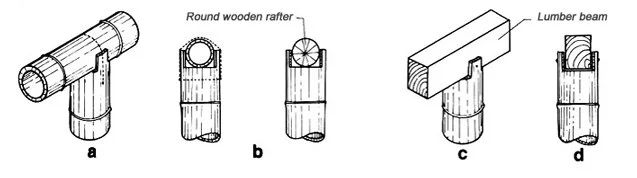
1. Joint with one or two ears. Is used to join bamboo rafters, logs or lumber.
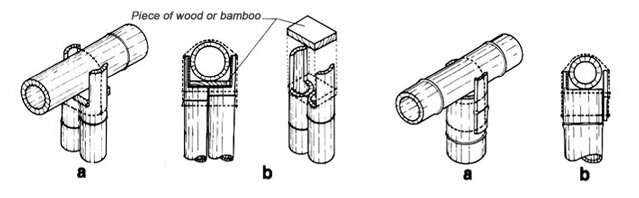
2. Flap joint. Is used when there is no lashing wire available. The flap can be secured with bamboo strips.
Bamboo Joinery Techniques
Making good and aesthetically pleasing bamboo joints is rather complicated because bamboo is hollow, tapered, has nodes at varying distances, and it is not perfectly circular. It is important to keep all these constraints in mind when designing a bamboo joint.
Although traditions, local practices and publications give some information on bamboo joinery, this information is far from complete as essential data is missing in most cases. Many traditional joinery techniques suffer from weakness or deformation, where the strength of the bamboo culm itself is lost.
Before bamboo gets widely adopted in modern architecture (and becomes affordable for all to use), the problem with bamboo joints and universal joining systems has to be solved. After all, timber, steel, and more recently prefabricated concrete, only became proper building materials for the same reasons. How many cumbersome solutions for joints have one seen, before these materials became a standard in construction?
Only if the problem with bamboo joinery can be satisfactorily addressed, and simplified, we can expect to see much more bamboo in Western buildings, bridges and furniture.
Below you’ll find some examples and illustrations of traditional bamboo joinery techniques.
Joining horizontal with vertical elements
1. Joint with one or two ears. Is used to join bamboo rafters, logs or lumber.
2. Flap joint. Is used when there is no lashing wire available. The flap can be secured with bamboo strips.
Use of dowels and anchors in bamboo joinery
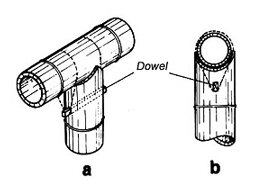
1. Joining bamboo with dowels and lashing. The peg should be placed in the column parallel to the rafter.
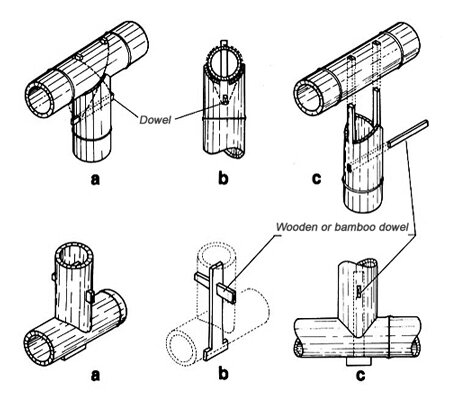
2. Bamboo fish mouth joint with pegs.
3. Bamboo joint with wooden anchor. Is also used inverted.
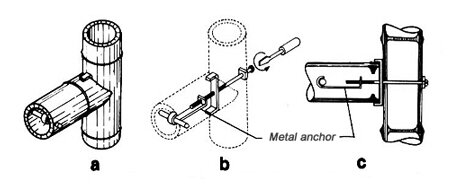
4. Bamboo joint with metal anchor. This technique Is used in various positions.
Double and quadruple bamboo rafter support
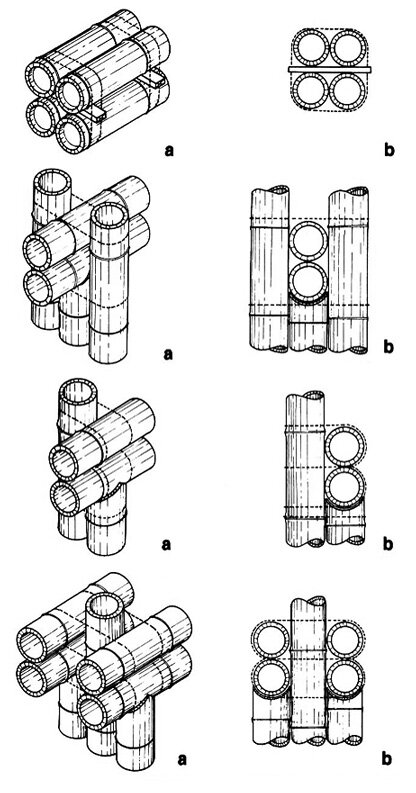
1. Beams formed by 4 or 6 members. The top row is separated from the bottom with wooden or bamboo slats so that the upper bamboos do not slide over the lower.
2. Central double rafter. It has a wide range of applications in the construction of bridges and structures for rural facilities.
3. Lateral double rafter. Each of the rafters is secured independently at the side support and each other. It is often used in the construction of bridges and structures for rural facilities.
4. Lateral double rafters. Is often used as a central support for bridge structures or sheds.
Joining and fixation of bamboo poles
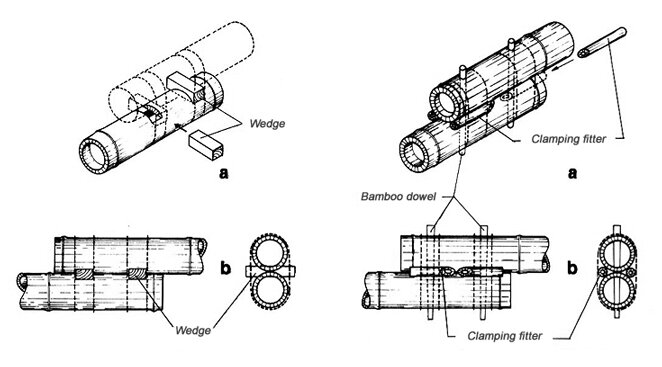
1. Joint with double wooden wedge | 2. Joint with dowels and clamping fitters
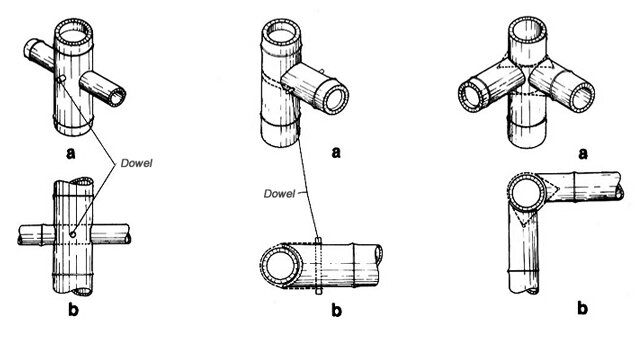
3. Cross joint with dowel | 4. Lateral joint with dowel | 5. Corner joint
Splicing bamboo poles
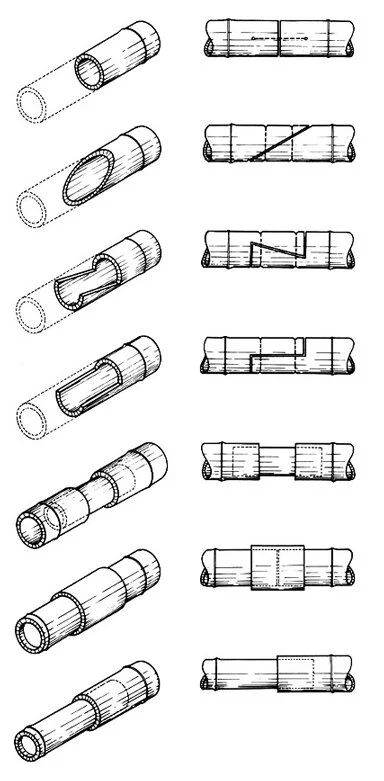
1. Top splicing
2. Bevel splicing
3. Ray splicing
4. Half bamboo splicing
5. Splicing with internal union
6. Splicing with external union
7. Telescope splicing
Source: Oscar Hidalgo Lopez, Manual de construcción con bambú.
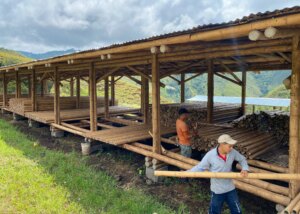
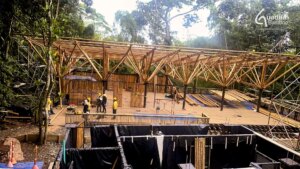
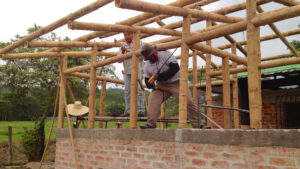
How to join a bamboo pyramid? I’m using guadua as the corner posts for a pyramid. Any suggestions as to how to join these at the top would be greatly appreciated. The lengths of the posts will be 8.5m, the pyramid base 9m x 9m. The height at the apex 6.5m. We need to get the joint exactly right to ensure the energetics of the structure are correct. Suggestions as to how to raise the posts are also appreciated.
Given the size of the structure I would start with a temporary, large diameter, center post. Cut each corner member to in a concave miter to meet the center post. (Using a 6×6 square post would be easier).
Once opposite members are leaning against the center, drill through all 3 members (opposing and center) and through the bolt. Bolts should stagger from those in the opposite direction which join the other two corner members.
Here is my advice:
Cut two pole ends in the right angle so that they have a flat surface where they touch. Cut it about 10 cm above a node in the pole to prevent it from splitting. Find a piece of bamboo that is just oversize to fit inside the bamboo poles. Scrape off the outside layer just until you can slide it in but with a tight fit. Insert them into both ends and cut them just above the node flush with the surface you cut at the large pole end. Take a piece of strong wood large enough to cover the (oval) pole ends about 2-3 cm thick. Trim of the excess wood sticking out. Place THICK dowels in the wood sticking out on BOTH ends. Mark the holes on the bamboo pole ends and drill them to the size of the dowels. Don’t drill too deep! Put a bucket load of (waterproof) glue on both ends of the wood, on the dowels, and the pole ends. (If you don’t find any glue in your underpants a week later, you did not apply enough glue.) Press both ends together and keep the PRESSED together until the glue is DRY. As in fully cured.
Provide a proper foundation for the poles that protects it from ground moisture. Either a concrete foot or a steel pipe in a bedding of gravel might do the trick. Do be cheap on the foundation. Unless you want big hospital bills from collapsing roofs etc. For this size, depending on weight of cladding, expected wind loads and snowfall I would say you need AT LEAST 1 m³ for every pole.
Good luck!
I have built many pyramids and other bamboo structures, the easiest way is to cut your pieces as closely to ideal. I assume that you are using the Great Pyramid scale…
Depending upon the diameter of the poles, bend some stiff wire or cable, if you want to use tension for stability, run the cable through the entire length of the pole, and use threaded ring bolts to draw the pieces together with washers (can be made with bamboo too).
If the piece is not going to be moved a lot, just use wire angles to hold the proper angles (Duct tape will help) and spray a large amount of “Good Stuff” spray foam into the joint. Use a small bent rebar in the foam joint, and trim off the excess with a razor blade. Paint the whole piece “Bamboo Green”, and the piece looks seamless!
Can’t remember where I saw it, but somewhere there was a video on cement filling of bamboo for added strength. The application was for attaching a ring to a pilaster. The PDF on the learning part of this site has the metal hardware demonstrated. The cement was filled into the joint by drilling a hole in the side of the pole and filling it with a mortar applicator (looks like a cake decorating tool). My question would be how long to let it cure and what problems arise from possible discoloration of the cement absorbing into the pole?
I saw some info about creating strong bamboo joints when using Guadua in building construction, especially adding cement to the joints. I recall threaded rod and hardware being used, and possibly rebar as well. I would love to see more detailed info and/or videos about that. Perhaps there are some good videos on the site already that I have missed.
Filling bamboo poles to reinforce the joints has shown very limited results. The problem arises from the fact that the cement mixture has water in it. So when injected in the bamboo cavity the bamboo sucks up part of the water from the mixture and the bamboo fiber swells up. When the cement or concrete sets it hardens and the bamboo dries. So it shrinks again. Pulling itself loose from the cement core and leaving a capillary opening between the bamboo and the cement. In addition to that, cement is very good at taking pressure-loads, but terrible at tensile strength (pulling). And it is heavy. So making a lightweight construction with bamboo does not seem to make much sense if you want to use heavy cement or concrete joints. Usually the motive for using cement is that it is cheap, and the builder (not being specialized in bamboo building but in general building) knows cement, but lacks the knowledge of using it in combination with bamboo.
There are better alternatives. One of them is using bamboo fiber with a matrix. A matrix is just a glue of some sort that fixes the fiber in place, mostly polymers made by chemical industry. Unfortunately good matrix-es usually do not come cheap and mostly are not very eco-friendly. But technically they are good and reliable. Basically what you do is building an exoskeleton of bamboo fiber held in place with the glue around the connection. Pretty much like you would make a cast around a leg when someone has a broken bone. The best results we had with a pre-woven strip of about 5 cm wide wrapped around the column in a cross overlapping pattern in MANY layers and then saturating it with the polymer. The best result are achieved when assuring both chemical AND mechanical bonding between the matrix and the bamboo. Mechanically is easy: roughen up the contact surface. Chemically is harder. But usually when you use a matrix that is properly absorbed by the bamboo fiber it should be ok. Keep in mind that the outside layer of the bamboo is not just hard by itself, but is hard because it contains a high level of silica. Making it more weather resistant, but also more anti-adhesive. Scraping it of before you apply the fiber and matrix might be a good idea.
Try sand power washing to roughen the boo. Try aircrete with lots of sand in it to lock rebar into place in the bamboo ends……you must also wrap the boo to prevent splitting……try making a boo frame and asting styro aircrete around it…..you may like it.
Maybe wash and soak the boo in h2o, then with borax, dry, then use deck stain to keep out water…..inside a styro aircrete structure, none of that is necessary.
I’m working on a project that requires a join like the one labeled “3. Bamboo joint with wooden anchor. Also used inverted.”
The two arms of the “T” will be subject to considerable forces — lateral, twisting, etc. The kinds of forces that would in play at the base of the mast of a sailboat.
Would you expect this joint, as diagrammed, to hold up? Can you suggest something more appropriate? Whatever I end up using will likely be reinforced with hemp/epoxy.
I think that building with round bamboo is only suitable for the very poor, or the very rich… It takes too long to do it right, not to mention the waste from constantly trying to make the bamboo joints acceptable to ‘high-end aesthetics’, or it looks like crap… I use a stationary motor with a tapered grinding stone, when I have to do it, but the dust is noxious, and it still takes too long…
My solution has been to make the rough joint bearing points as close as possible, and to use wood plugs as you do, but to make the bamboo joint pleasing to the eye, I just use spray foam (I know, that’s not too eco appropriate) which stabilizes and fills the gaps, then trim it with a sharp razor, and paint it to match. It comes out looking like your pictures, and stops bugs from attacking the end cuts, and takes a fraction of the time to do…
I also use wine bottles foamed into the ends of bamboo poles for bearing on the ground, or connecting two bamboo poles into one longer one. Sometimes I put a few LEDs in the ends on the ground to make a cool way to keep from stubbing your toes in the dark…
What is the best hand saw tool to use for cutting joints? I want to make precise fish mouth joints cuts while leaving two pegs so I won’t need glue to join a vertical piece to a horizontal piece.
What kind of rope is used for the lashing? I’ve been trying to use jute twine from Home Depot to build a small sun shade for pool equipment and a 6’x6′ square garden trellis but no matter how tight I tie them the joints are loose within a day or two. I’ve been using both Japanese Square Knot for the cross joints and fish mouth with dowel using the picture on this page. All of them loosen up.
For lashing with jute rope, the rope should be soaked in water for about an hour before it should be used. Then it will not get loosen up.
Is Manila rope good for connecting bamboo?
Wow! Great find! Thank you for sharing these! However, do you have other connection details such as roof connection details & bamboo to concrete connection details? Thanks!
This is very useful information. I just wanted to know what and which adhesives should we use to hold two bamboos together?
The Corner Joint is not clear at all … Is it a dowel being used?