

In Latin America, farmers often use bamboo as beehives. Bamboo internodes (the part between 2 nodes) of larger diameter bamboo species such as Guadua angustifolia or Dendrocalamus asper are very well suited to make a bamboo beehive. A closed piece of bamboo is suspended horizontally under the roof of a house or shed, and a small hole made in one node at one end enables the bees to enter.
After a few days, the enclosed bamboo beehive will attract bees to live and raise their young. The presence of the bees can be seen when there is a waxy entranceway protruding from the hole that we made earlier (see pictures below).
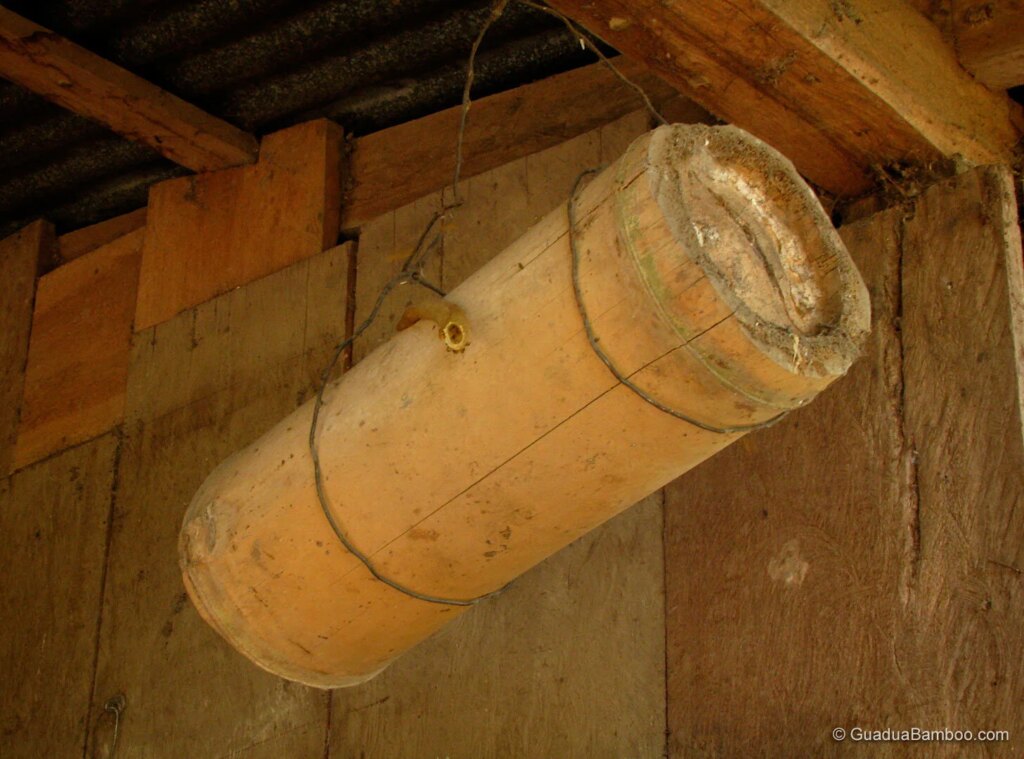
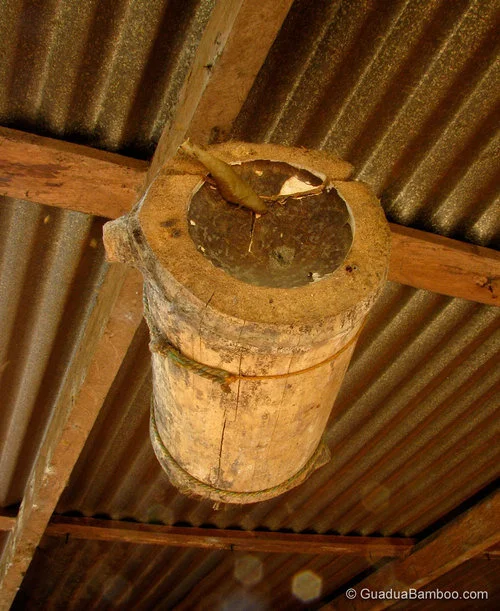
The bees will create a densely packed matrix of hexagonal cells made of beeswax (honeycomb) inside the bamboo. They use the cells to store their honey, and to house eggs, larvae, and pupae. After about 4-6 weeks their honey can be harvested from the bamboo internode by splitting it length-wise with a machete.
Honey doesn’t only taste great, it is also a natural energy booster and has a lot of health benefits because of its antibacterial properties. In Central America, farmers also use this “bamboo honey” to treat eye infections.
Help Preserve our Bee Population and Get Your Own Bamboo Beehive!
The honey bee is dying. Not just in North America, but around the world, bees are losing their ability to forage for food necessary to sustain themselves. The reasons are varied and complex – pesticides, mites, viruses, genetic engineering of crops – but they all add up to one thing: Bees are not able to return to their hives with enough food to sustain the colony through winter.
Bees are crucial to maintaining our global food supply. Most people know that bees are responsible for pollinating about 1/3 of our food supply, but did you know that without them we would be unable to eat delicious foods like apples, cucumbers, or almonds? If we truly want to preserve the health of our bee population, it is vital that we do something about it. By installing a beehive in your garden, you can help support our bees and their important work.

I have some bamboo hives of the sting-less bee Tetragonisca angustula. I now started researching D. asper to build homes for this species and others of the sting-less bees.
Some of my work can be seen at: https://www.youtube.com/channel/UCvkI-WfS5332s4we892mtgg
My question is which is the best method to dry the bamboo? Some people use torches to apply heat, etc.
Just put the bamboo to dry in the sun (rotate every day to avoid cracking). Flame torching is most suited for small diameter green bamboo, not so much for large diameter bamboo. Sun drying will take about 2 weeks for small sections, but do make sure to use mature Dendrocalamus asper otherwise it will crack easily.
My daughter bought me a bamboo filled bee home. All the bamboo tubes are filled with what looks like rolled leaves. I’m not sure if I should clean these tubes out or leave them. I know you said to clean out the home but does that include the tubes?
Will this attract hornets??? I live in the NW USA and want to start bees but want to be sure I don’t ask the local hornets and yellow jackets to hang around! 🙂
Upon honey harvesting, is the bamboo beehive still in tact or does splitting it with the machete mean a new one has to be built?
Yes we just split the bamboo open, bamboo enough here… But maybe you could fabricate something with 2 bamboo halves and small hinges.
I am fascinated with this Guadua Bamboo honey beehive. How big is the cane used? What size hole is drilled for the bees?
We used 4 inch diameter bamboo but 5" or 6" would just work as well. For this type of bees a 5 mm hole is good enough.