

Chemical preservation (with or without the help of special equipment) ensures long term protection. Depending upon the method of bamboo treatment, chemical preservatives can impart short term or long term protection.
With a few exceptions, chemical preservatives to protect bamboo against biological attacks and degradation are toxic. Selection and application has to be done with great care to meet performance, environment requirements and safety.
Depending upon the carrier solvents, bamboo preservatives are divided into 2 different categories: Non-fixing and fixing type preservatives. Non-fixing preservatives will leach out the bamboo when exposed to rain. In other words non-fixing type preservatives are NOT suited for outdoor use.
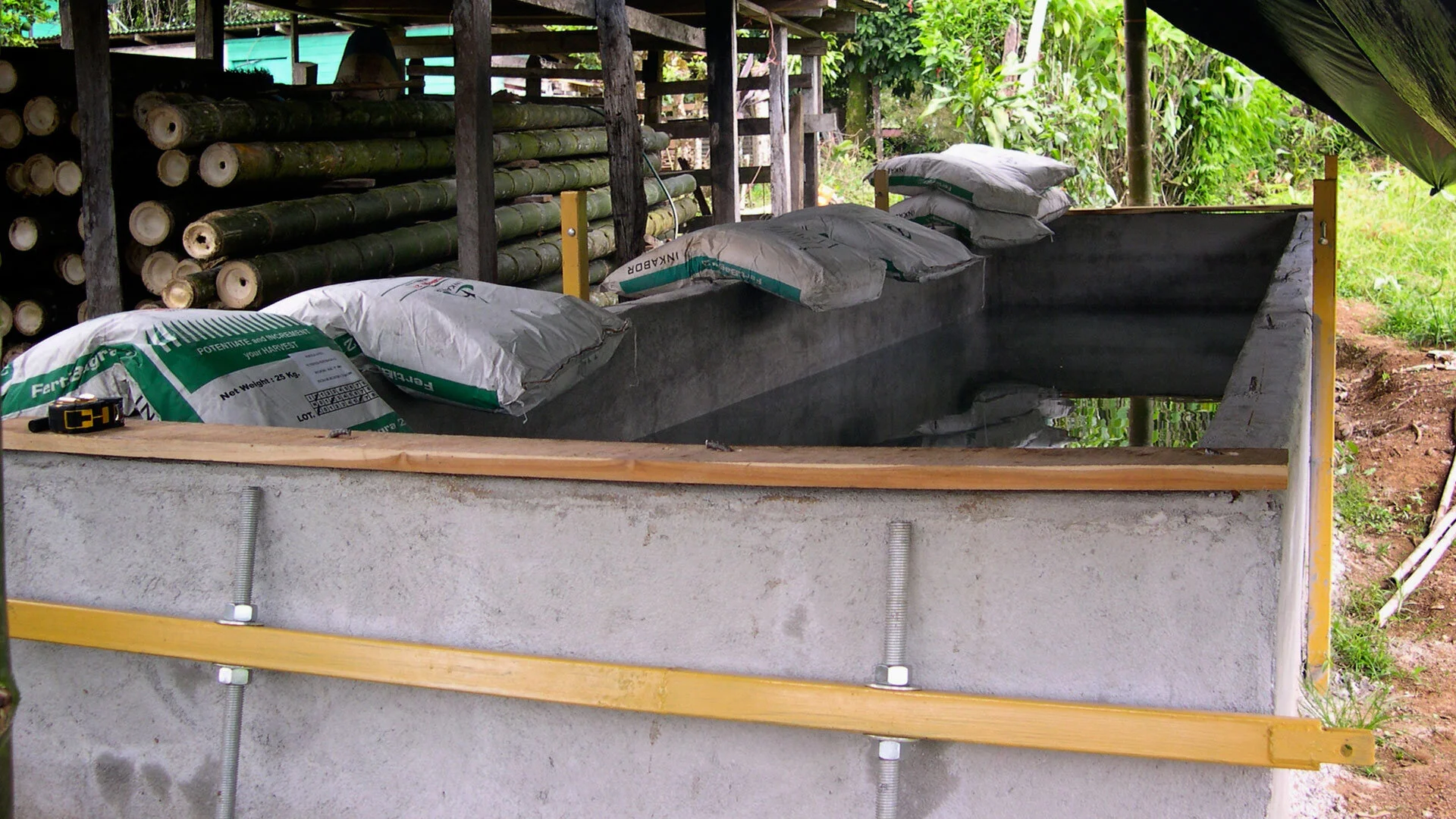
Non-Fixing Type Preservatives
Non-fixing bamboo preservatives mainly consist of boron salts, which are effective against borers, termites and fungi (except soft rot fungi). These boron salts are dissolved in water. After treatment, the water evaporates leaving the salts inside the bamboo. They are not toxic and can be used for treating bamboo products like baskets, dry containers, etc. which come in contact with food products.
Boric Acid Borax
Curing bamboo with borax and boric acid is the most popular bamboo preservation method (for indoor use) around the world because it is effective and more environmentally friendly than other wood preservatives.
The combination of boric acid and borax in a ratio of 1:1.5 is an alkaline salt called: Disodium octaborate tetrahydrate (Na2B8O13 x 4H2O) and is available in pre-mixed powder form, usually under the commercial names: Tim-Bor or SoluBor, among others.
Disodium octaborate tetrahydrate is a white, odorless, powdered substance that is not flammable, cumbustible, or explosive and has acute low oral and dermal toxicity. The product itself is fire retardant and shows no hazardous decomposition.
This salt, is used as an insecticide and fungicide, and is also effective against fungi and algae. It has an infinite shelf life and is not affected by temperature. Diluted with water, bamboo can be impregnated, submerged or sprayed with this chemical.
Formula (1):
- boric acid / borax
- ratio 1:1.5
Formula (2):
- boric acid / borax / sodium dichromate
- ratio 2:2:0.5
Recommended concentration:
- 4-5% indoor use (not exposed to weather or ground contact)
* How to Interpret the Terms: ‘Ratio’ and ‘Concentration’?
The ratio of the chemical solution is based on kilograms per 100 liters of water.
For example, if you see this:
- boric acid / borax / sodium dichromate
- ratio 2:2:0.5
It actually means this:
- a mixture of 2 kg of boric acid / 2 kg of borax / 500 gr of sodium dichromate in 100 liters of water.
The above example is the equivalent of 4,5% concentration. If you want to ramp this up to a concentration of 9% you just have to double the mixture like this:
- a mixture of 4 kg of boric acid / 4 kg of borax / 1 kg of sodium dichromate in 100 liters of water.
Fixing Type Preservatives
These chemical bamboo preservation formulations are proportionate mixtures of different salts which interact with each other in the presence of bamboo and become chemically fixed. In principle, the degree of fixation and efficacy depends upon the nature of the components and their combination and concentration.
For example, Chromium is responsible for fixation, copper is effective against decay fungi and soft rot and the third compound acts against insect and fungus. The process of fixation requires some weeks during which the material should be stored under cover. Slow fixation is preferred in case of bamboo as it allows diffusion and better distribution of preserving salts.
Copper Chrome Arsenic (CCA)
CCA is a heavy duty broad spectrum chemical bamboo preservative patented as AsCu. It has been found to provide protection for 50 years or more. Outdoor use is recommended only due to the arsenic component, which can also causes a green coloration on the bamboo.
Formula:
- arsenic pentoxide / copper sulphate / sodium dichromate
- ratio 1:3:4
Recommended concentration:
- 6% outdoor use (structures exposed to weather but not in contact with ground)
- 10% outdoor use (structures exposed to weather and in ground contact)
Copper Chrome Boron (CCB)
CCB is a broad spectrum chemical bamboo preservative and a good alternative to CCA, but less effective with a lower degree of fixation, because of the boron component.
Formula:
- boric acid / copper sulphate / sodium dichromate
- ratio 1.5:3:4
Recommended concentration:
- 6-8% indoor use (not exposed to weather or ground contact)
- 8-10% outdoor use (structures exposed to weather and in ground contact)
Zinc Chrome
Zinc Chloride is highly hygroscopic and treated bamboo will give a wet look in rainy season. This can adversely help paints and other finishes.
Formula:
- Zinc chloride / sodium dichromate
- ratio 1:1
Recommended concentration:
- 10% outdoor use (structures exposed to weather and in ground contact)
Copper Chrome Acetic
Formula:
- copper sulphate / sodium dichromate / acetic acid
- ratio 5.6:5.6:0.25
Recommended concentration:
- 8% outdoor use (structures exposed to weather and in ground contact)
Fire Retardant Preservative
This treatment is intended to protect materials against fire as well as decay and insect attack.
Formula:
- boric acid / copper sulphate / zinc chloride / sodium dichromate
- ratio 3:1:5:6
Recommended concentration:
- 25% indoor and outdoor use
Creosote
It is a broad spectrum bamboo preservative and is a cost effective chemical for treatment for exterior applications. It has been used for treating railway sleepers and wooden poles.
Coal tar and creosote available from coal is a dark brown viscous liquid. Creosote should be used exclusively for pressure processes or hot and cold treatment. Being oily, it imparts water repellence to the treated material. It is effective against fungal and insect attack. Due to its dark brown color and bad odor, its use is restricted to exterior applications, especially in contact with mud/ ground.
Light Organic Solvent-based Preservatives (LOSP)
These are slightly more expensive bamboo preservatives where the organic solvent acts as a carrier for toxic molecules and later evaporates, leaving the active ingredients behind. They are available commercially in ready-to-use forms. A good formulation is an appropriate mixture of fungicides and insecticides. There is little change of color of the treated material but a residual odor may remain for some time. The method of use will be recommended by the manufacturer. Formulations available in concentrates are more economical to use.
Trichlorophenol (TCP)
It is a more eco friendly substitute for Pentachlorophenol. Ready to use (5%) solution of this fungicide along with insecticides for broad spectrum performance are commercially available. Concentrates which can be diluted with mineral turpentine oil are more economical for industrial use.
Copper/Zinc soaps
They have emerged as alternatives to other organic preservatives which cause environmental hazards. Napthenates of copper and zinc are most common (metallic soaps). They are available as ready-to-use formulations containing appropriate amounts of insecticides. They are slightly more expensive than TCP formulations. However, they are more eco-friendly and also have no pungent smell.
I am designing a house to suite the emerging middle class in Ghana, looking to understand more about bamboo preservation techniques that offer excellent protection against rot and insects.
From what I’ve read thusfar, it seems that chemical treatments will be most effective, and I am searching for a solution that will be environmentally safe, to both nature and the inhabitants. Any recommendations, especially with regards to being situated in southern Ghana (a hot and humid climate with two distinct rainy seasons each year)?
In regards to its toxicity, boric acid naturally occurs in the environment. It can be found in soil, water, and plants. Boric acid dissolves in water and can move with water through the soil. Under certain soil conditions it can reach ground water. However, its mobility in soil depends on pH and the presence of some metals. Boric acid can also be taken up from the soil by plants. It moves through plants into their leaves. Once there, it generally becomes stuck and does not move into the fruit. Plants need boron, a major component of boric acid, to grow. However, too much boron can be toxic to plants affecting their growth. Citrus, stone fruits, and nut trees are most sensitive to boron.
Boric acid does not emit vapors into the atmosphere. Particles that get into the air do not break down. They settle to the ground or are removed by rain.
Boric acid is practically non-toxic to birds. It is slightly toxic to practically non-toxic to freshwater fish. Boric acid is practically non-toxic to frogs and toads and aquatic life, such as waterfleas. The U.S. EPA concluded that boric acid is relatively nontoxic to bees.
Source: http://npic.orst.edu/factsheets/boricgen.html
What’s the notion of this preservation technique? Cut green culms and place them in a 5 gal. bucket with 3 gals. of a 10 % solution of Timbor (a borax / boric acid solution) in water. This happens in the grove for a month.
Shouldn’t the boric solution be drawn up the culm by capillary action yielding a cured culm in a month? After a month remove the culms to finish drying vertically in a shady spot for another month. What do you think?
What you’re describing is a soak-and-draw treatment, it’s basically using the fresh culm’s own capillary action to pull the borax/boric acid solution up and replace the sugars that bugs love. A month standing in the bucket is usually more than enough (even 1–2 weeks can do it), then drying vertically in the shade is the right call to avoid cracks.
Just keep in mind uptake isn’t always even, especially on thicker culms, and older poles (3–5 yrs) will be more durable. For max protection, full soak or sap displacement works better, but this setup can give you serviceable, bug-resistant bamboo (especially for small- to medium-diameter poles).
I have invented a way to cure bamboo at site using a non-toxic 10:1 CuSO4 solution. I drill holes around the base of the culm section above a node so that all the vascular bundles are pretty much compromised. Then I rasp off the debris and seal the holes with gladwrap or tape. I then drill a couple of big holes at the top of the culm section and add the solution (one hole to let the air out).
The bamboo does not go into shock and dies slowly in place, ensuring a better uptake of solution and displacement of sugars. I have had great results….and the bamboo does not blow over or fall out of the buckets. I think very little Cu finds its way down into the roots, no discoloration below the holes, and the clumps are healthy.
Hi, really like your technique, so it’s all happening without cutting the bamboo and it stays up? How do you drill the top of the culm and access it? Or is it all done on a lower node at the base and the liquid goes up? Do you think you could share a photo or a video of the process?
Couple of cautions though: copper sulfate is effective against rot and insects, but it’s a heavy metal salt, not as “non-toxic” as borax/boric acid, and it can build up in the soil over time. It can also leave a green/blue stain in the bamboo and sometimes causes issues with fasteners later.
Honestly, I’m surprised it doesn’t knock back the clump, copper is usually pretty hard on plants. If it’s really leaving the grove healthy, that’s unusual.
i m from Bangladesh in Chittagong,,,For light pole & net fencing pole of bamboo,,,What’s the right formula for 15 years of bamboo protectionThanks
Hello Stephane,
In the ratios you mention for Boric Acid and Borax 1:1.5. This means for every 100 liters of water its 1kg of Boric Acid and 1.5kg of Borax, What % of concentration you get with this ratio? 2.5%? If i want a 5% solution should i double it?
Thank you for the information.
Hello, this is Anuradha. Want to know is treatment and chemical persentage depends upon bamboo species. If yes, then pls guide me.
I want to use boric acid, borax and sodium dicromet combination. But how long it has to be submerged or putting in cohesion and adhesions process? There’s nothing about time in the write-up.
The bamboo should be submerged for 4-5 days.
Is it advisable to treat bamboo chemically after heat treatment? What are the benefits?
How long of a soak is necessary to facilitate chemical treatment? Is it equivalent to or better than promptly soaking in trough of chemical treatment post-harvest?
I have seen boric acid and it could have been hydrogen peroxide injected into the culms under pressure from CO2, the chlorophyll and sugars run out as the solution went into the bamboo but that is all I know. The bamboo was then dried pretty quickly and was ready to build homes in a couple of weeks as I was told. Can anyone explain this process?
Why is the "Bamboo Preservation" done horizontal and not vertical or in a angel? Now many air will stay in the bamboo and where there is air there is no liquid?
Dear Albert, Bamboo preservation should be horizontally due to the penetration of preservative into vessels easily, vessels structure permit that way.