

Chemical preservation (with or without the help of special equipment) ensures long term protection. Depending upon the method of bamboo treatment, chemical preservatives can impart short term or long term protection.
With a few exceptions, chemical preservatives to protect bamboo against biological attacks and degradation are toxic. Selection and application has to be done with great care to meet performance, environment requirements and safety.
Depending upon the carrier solvents, bamboo preservatives are divided into 2 different categories: Non-fixing and fixing type preservatives. Non-fixing preservatives will leach out the bamboo when exposed to rain. In other words non-fixing type preservatives are NOT suited for outdoor use.
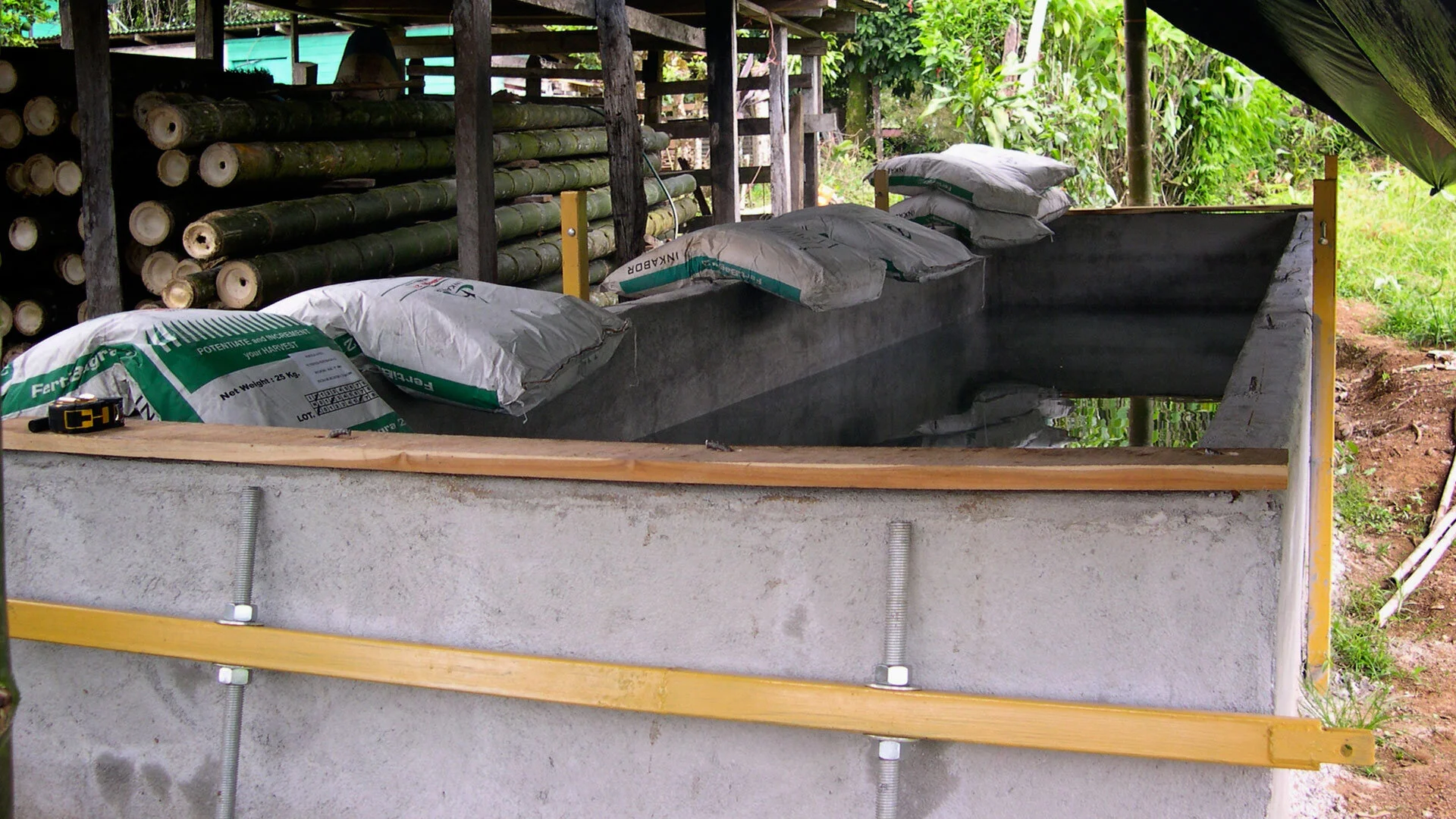
Non-Fixing Type Preservatives
Non-fixing bamboo preservatives mainly consist of boron salts, which are effective against borers, termites and fungi (except soft rot fungi). These boron salts are dissolved in water. After treatment, the water evaporates leaving the salts inside the bamboo. They are not toxic and can be used for treating bamboo products like baskets, dry containers, etc. which come in contact with food products.
Boric Acid Borax
Curing bamboo with borax and boric acid is the most popular bamboo preservation method (for indoor use) around the world because it is effective and more environmentally friendly than other wood preservatives.
The combination of boric acid and borax in a ratio of 1:1.5 is an alkaline salt called: Disodium octaborate tetrahydrate (Na2B8O13 x 4H2O) and is available in pre-mixed powder form, usually under the commercial names: Tim-Bor or SoluBor, among others.
Disodium octaborate tetrahydrate is a white, odorless, powdered substance that is not flammable, cumbustible, or explosive and has acute low oral and dermal toxicity. The product itself is fire retardant and shows no hazardous decomposition.
This salt, is used as an insecticide and fungicide, and is also effective against fungi and algae. It has an infinite shelf life and is not affected by temperature. Diluted with water, bamboo can be impregnated, submerged or sprayed with this chemical.
Formula (1):
- boric acid / borax
- ratio 1:1.5
Formula (2):
- boric acid / borax / sodium dichromate
- ratio 2:2:0.5
Recommended concentration:
- 4-5% indoor use (not exposed to weather or ground contact)
* How to Interpret the Terms: ‘Ratio’ and ‘Concentration’?
The ratio of the chemical solution is based on kilograms per 100 liters of water.
For example, if you see this:
- boric acid / borax / sodium dichromate
- ratio 2:2:0.5
It actually means this:
- a mixture of 2 kg of boric acid / 2 kg of borax / 500 gr of sodium dichromate in 100 liters of water.
The above example is the equivalent of 4,5% concentration. If you want to ramp this up to a concentration of 9% you just have to double the mixture like this:
- a mixture of 4 kg of boric acid / 4 kg of borax / 1 kg of sodium dichromate in 100 liters of water.
Fixing Type Preservatives
These chemical bamboo preservation formulations are proportionate mixtures of different salts which interact with each other in the presence of bamboo and become chemically fixed. In principle, the degree of fixation and efficacy depends upon the nature of the components and their combination and concentration.
For example, Chromium is responsible for fixation, copper is effective against decay fungi and soft rot and the third compound acts against insect and fungus. The process of fixation requires some weeks during which the material should be stored under cover. Slow fixation is preferred in case of bamboo as it allows diffusion and better distribution of preserving salts.
Copper Chrome Arsenic (CCA)
CCA is a heavy duty broad spectrum chemical bamboo preservative patented as AsCu. It has been found to provide protection for 50 years or more. Outdoor use is recommended only due to the arsenic component, which can also causes a green coloration on the bamboo.
Formula:
- arsenic pentoxide / copper sulphate / sodium dichromate
- ratio 1:3:4
Recommended concentration:
- 6% outdoor use (structures exposed to weather but not in contact with ground)
- 10% outdoor use (structures exposed to weather and in ground contact)
Copper Chrome Boron (CCB)
CCB is a broad spectrum chemical bamboo preservative and a good alternative to CCA, but less effective with a lower degree of fixation, because of the boron component.
Formula:
- boric acid / copper sulphate / sodium dichromate
- ratio 1.5:3:4
Recommended concentration:
- 6-8% indoor use (not exposed to weather or ground contact)
- 8-10% outdoor use (structures exposed to weather and in ground contact)
Zinc Chrome
Zinc Chloride is highly hygroscopic and treated bamboo will give a wet look in rainy season. This can adversely help paints and other finishes.
Formula:
- Zinc chloride / sodium dichromate
- ratio 1:1
Recommended concentration:
- 10% outdoor use (structures exposed to weather and in ground contact)
Copper Chrome Acetic
Formula:
- copper sulphate / sodium dichromate / acetic acid
- ratio 5.6:5.6:0.25
Recommended concentration:
- 8% outdoor use (structures exposed to weather and in ground contact)
Fire Retardant Preservative
This treatment is intended to protect materials against fire as well as decay and insect attack.
Formula:
- boric acid / copper sulphate / zinc chloride / sodium dichromate
- ratio 3:1:5:6
Recommended concentration:
- 25% indoor and outdoor use
Creosote
It is a broad spectrum bamboo preservative and is a cost effective chemical for treatment for exterior applications. It has been used for treating railway sleepers and wooden poles.
Coal tar and creosote available from coal is a dark brown viscous liquid. Creosote should be used exclusively for pressure processes or hot and cold treatment. Being oily, it imparts water repellence to the treated material. It is effective against fungal and insect attack. Due to its dark brown color and bad odor, its use is restricted to exterior applications, especially in contact with mud/ ground.
Light Organic Solvent-based Preservatives (LOSP)
These are slightly more expensive bamboo preservatives where the organic solvent acts as a carrier for toxic molecules and later evaporates, leaving the active ingredients behind. They are available commercially in ready-to-use forms. A good formulation is an appropriate mixture of fungicides and insecticides. There is little change of color of the treated material but a residual odor may remain for some time. The method of use will be recommended by the manufacturer. Formulations available in concentrates are more economical to use.
Trichlorophenol (TCP)
It is a more eco friendly substitute for Pentachlorophenol. Ready to use (5%) solution of this fungicide along with insecticides for broad spectrum performance are commercially available. Concentrates which can be diluted with mineral turpentine oil are more economical for industrial use.
Copper/Zinc soaps
They have emerged as alternatives to other organic preservatives which cause environmental hazards. Napthenates of copper and zinc are most common (metallic soaps). They are available as ready-to-use formulations containing appropriate amounts of insecticides. They are slightly more expensive than TCP formulations. However, they are more eco-friendly and also have no pungent smell.
If bamboo can be treated with ACQ. How much is effective for bamboo. What concentration of ACQ is required for bamboo by vacuum pressure treatment. Is anybody is using ACQ for bamboo treatment?
I am planning to use borax and boric acid treatment for the bamboo fibers for using it as a reinforcement in concrete as a project work. Will this treatment reduce the water absorption property of bamboo fibers and ensure good bonding with concrete?
How long does the bamboo have to stay submerged in the boric acid borax mix? And do I have to heat it?
For several posters here; Please see Ariel Rabik’s work in Indonesia. His book is Towards Resilient Bamboo Forestry. The Enviromental Bamboo Foundation is doing great work in these enviromental and economic fields. And bamboo preservation is a basic component.
What’s the negative things about the copper/zinc soaps, besides the price. Is it good for big structures? How long does it last?
What is the best/safest treatment for bamboo straws or those bamboos that will have food contacts?
Hello, I am experimenting preservation by treating each node cavity individually after construction. The process is simple. We drill a hole in the sidewalk of the node cavity near the top and then spray Chandrite termite ant beetle treatment into the void for 3 to 5 seconds ( depends on size) then follow up with an additional spray of lacquer paint then immediately plug the hole with dowel. Has anyone tried this before? So far so good 6 months.
With the treatments that you have listed, what are the degradation times for bamboo including if it is not treated?
I would like to know if the fire retardant treatment in your website is suitable for outdoor usage especially for ground or mud contact?
boric acid / copper sulphate / zinc chloride / sodium dichromate
Is this the most cost effective treatment for all rounded indoor and outdoor usage?
Would appreciate your advice on this. Thank you.
I work with bamboo baskets made with the untreated inner part of bamboo and I have been experiencing mold and borers every so often. I am thinking of treating it with the boric acid/borax solution but since I do not have a big tank to soak all the baskets for a long time, I am planning to simply submerge them for a minute or so in a bucket and then let them dry and absorb the salts.
Do you think that would work? The baskets are to be displayed indoors.
You need cold water, borax/boric acid, a bucket half the size of the pole, and patience.
Warm some water to dissolve the solution and pour it on the bucket with the poles and the cold water. Wait for one week, then turn the poles upside down and repeat the process.
It will work with recently-cut poles and no more than 2 m in length.