

The bamboo stem (culm) is the most utilized part of the bamboo plant, and consists of 3 parts:
1. Stem
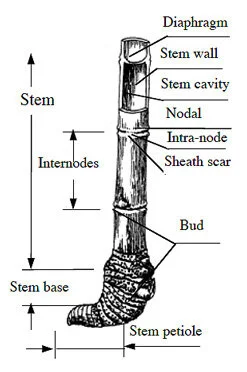
The stem is the part of the bamboo plant that grows above the ground, it is usually straight and cylinder-formed (to some extent oval). These bamboo stems have nodes (diaphragms) between two internodes, that strengthen the stem.
The length, number and form of nodes and internodes depend on the bamboo species. Internodal length is also much shorter towards the base of the culm compared to the internodal length towards the tip of the culm.
Every node has two closely positioned rings, the lower one is called sheath ring, which is a scar formed after the sheath leaf falls off. The upper one is called stem ring, which is a scar formed after the growth-cease of internode tissue. The part between the rings is the node itself.
Bamboo internodes are usually hollow inside and form bamboo cavities. Depending on the bamboo species, wall thickness of the stem can vary greatly from thin walled to even solid. A good example of a near solid bamboo species is Guadua amplexifolia.
2. Stem Base
The lower part of a bamboo stem is called stem base, it extends into the soil and connects to the rhizome and root system. A stem base consists of numerous short sections with significant diameter, adventitious roots grow densely on these sections. On the stem bases of some bamboo species there are up to ten alternate buds, which grow into shoots and then into bamboo stems; on those of some other species the buds are fewer, and can grow into rhizomes.
3. Stem Petiole
The stem petiole is the lowest part of the bamboo stem, and consists of tens of short sections. The diameter of these sections decrease with the depth of the petiole. A stem petiole is generally solid, with degenerated leaves, without buds.

How many internodes has an average bamboo culm?
The average number of bamboo internodes greatly depends on the species, but in case of Guadua angustifolia a 20 m tall culm has on average 75 internodes. The first 18 internodes (from the ground up) have an average length of 22 cm, the next 18 internodes on average 34 cm, the next 18 internodes on average 36 cm, and the remaining internodes on average 14 cm.
In BAMBOOS OF THAILAND there are several tables in which the number of culm-nodes and their corresponding culm length above the ground, the number of internodes, their length, diameter and wall width are listed.
Such tables are available of the following species:
Bambusa pervariabilis, Bambusa textilis, three unidentified Bambusa species, Cephalostachyum pergracile, three unidentified Dendrocalamus species, Lingnania distegia, one unidentified Schizostachyum species, and ×Thyrsocalamus liang.
What determines the length of bamboo internodes? Is it the species only, or are there other factors involved?
The length of bamboo internodes varies greatly from species to species, and the climate and soil it is grown in. Also, bamboo internodes are much shorter towards the base and tip of the culm (stem) compared to the internodal length in the middle of the culm.
Generally speaking the more nodes, the stronger the bamboo. A bamboo culm is at its strongest at the base (largest diameter, more nodes, thickest walls), that’s because it has to support the weight of the entire culm, branches and leaves.
So why are the internodes also short toward the tip of the bamboo? This has two reasons:
1. The branches grow from the nodes. Most bamboo species have little to no branches in the middle of the culm, but primarily at the top, and sometimes near the base. That’s why there are more nodes and shorter internodes at the top.
2. Since there is a lot of weight from branches and leaves at the top, it also has to be strong and flexibel. Hence, lots of nodes and short internodes.
hello, can you post something about bamboo culm sheaths? are they fibrous?
If I remove the rhizome but leaving some roots (feeding root) which they were connected to the rhizome will they grow to new bamboo?
No, because the rhizomes store the nutrients for new growth.
Is the air in a bamboo culm’s internode cavity older than the outside air?
I thought the same thing. what is the purpose of the sealed off portion of the cavities?